Constituent Materials Tab
|
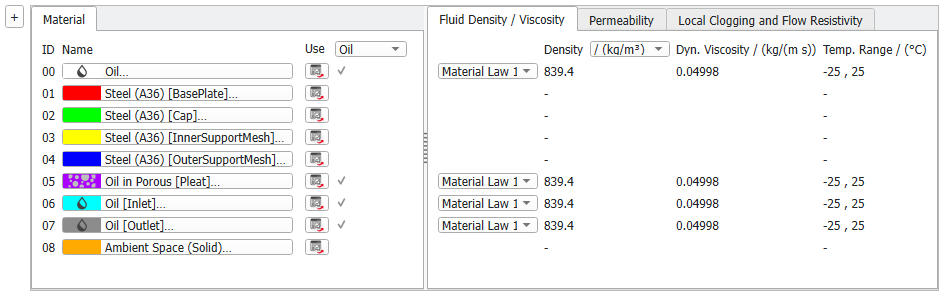
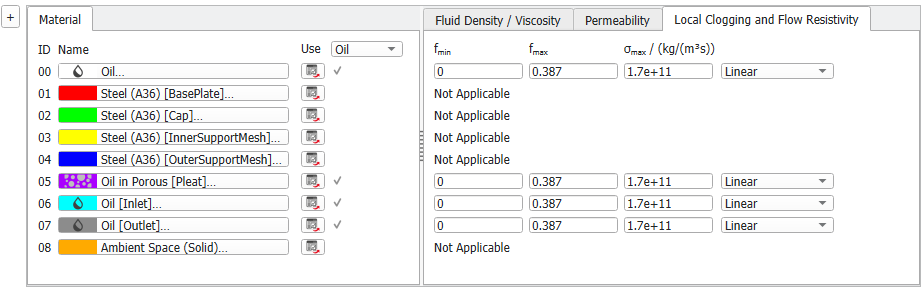
Experimental setup and material parameters: We use oil with a density of 839.4 kg/m³ and viscosity of 0.04998 kg/(m s). The filter media itself has an initial (clean) through-plane permeability of 4.96 e-11 m². In the depth filtration As test dust, we use ISO 12103-1 A3 Medium Test Dust (Arizona Test Dust) which has a specific density of 2650 kg/m³. The bulk density of loose A3 dust is 1.025 kg/m³, which corresponds to a solidity of 38.7 %. A filter cake of this test dust has an oil flow resistivity of 1.7e+11 kg/(m³s). |

- In the Constituent Materials tab, check that the materials are set as shown in the screenshot, which should be the case if you have followed the previous steps of this tutorial. In the Fluid Density / Viscosity subtab, the values for the material Oil are taken from the material database and we do not have to set them manually.
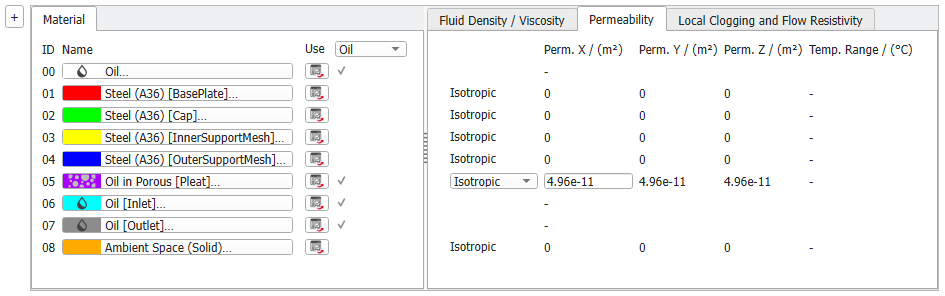
- In the Permeability subtab, select Isotropic and enter the permeability 4.96e-11 m² of the clean filter media.
|
Filter Permeability Values: Filter materials are typically not isotropic and their permeability will differ between through-plane and in-plane directions. The permeabilities entered in the dialog are given in the X, Y, Z space directions, which are typically not aligned with the through-plane and in-plane direction of the filter material. However, the flow direction is always in the through-plane direction, so the through-plane permeability is the only value of relevance. Therefore, always enter the through-plane permeability for all space directions! |

- In the Local Clogging and Flow Resistivity tab, enter the maximum solidity 0.387 of the filter cake as and the corresponding flow resistivity 1.7e+11 as . Do this for all pore and porous materials (ID 00, ID 05, ID 06, ID 07).
|
Filter Cake: The solidity and flow resistivity of the filter cake is often unknown. If you cannot derive these values from experimental results, you can make a good estimate by using the GrainGeo - Pack Analytic Spheres command to create a 3D structure model of the filter cake with the given test dust particle size distribution and a desired packing density (solidity). You can then use FlowDict to compute the flow resistivity of the filter cake based on this 3D model. |