Speaker: Patrick Jasek, Research Associate, DGE / Technical University of Leoben
From Pore-Scale Reactive Transport to Reactor Performance: Quantifying Geomethanation Efficiency
Abstract
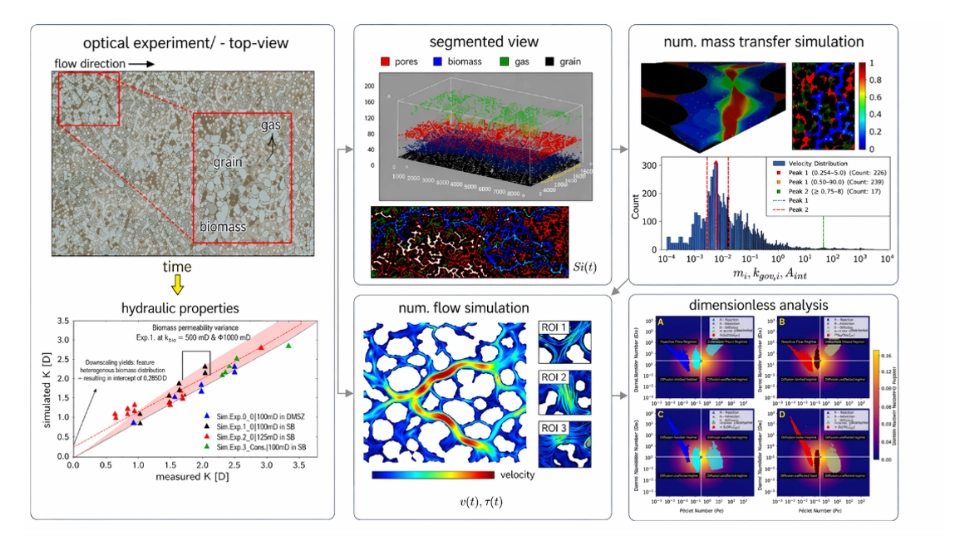
Geomethanation in depleted gas reservoirs offers a route to couple subsurface hydrogen storage with in situ methane production, but its efficiency depends on the interaction between microbial growth, pore-space alteration, and gas-liquid mass transfer. Building on a coupled microfluidic-numerical workflow, we combine results from saturated and unsaturated experiments to quantify how pore-scale processes control reactor-scale performance.
Under saturated conditions, biomass accumulation reduced porosity yet preserved substantial permeability because channel formation and intrinsic biomass conductivity maintained flow; simulations indicated an intrinsic biomass permeability of about 100 ± 50 mD, supporting continued advective nutrient supply. Under unsaturated conditions, gas injection shifted biomass from colony-dominated structures to a planktonic, interface-associated state, enhancing substrate access at gas–liquid boundaries.
The integrated analysis showed methane evolution rates rising to about 0.30-0.35 mmol L⁻¹ h⁻¹, while dimensionless evaluation identified predominantly reaction-limited behavior despite improved transport. Finally, this study establishes a workflow linking pore-scale morphology, transport regimes, and methane productivity for assessing geomethanation efficiency.