Computational analysis and optimization of filters with GeoDict, from filter media to filter element
Abstract
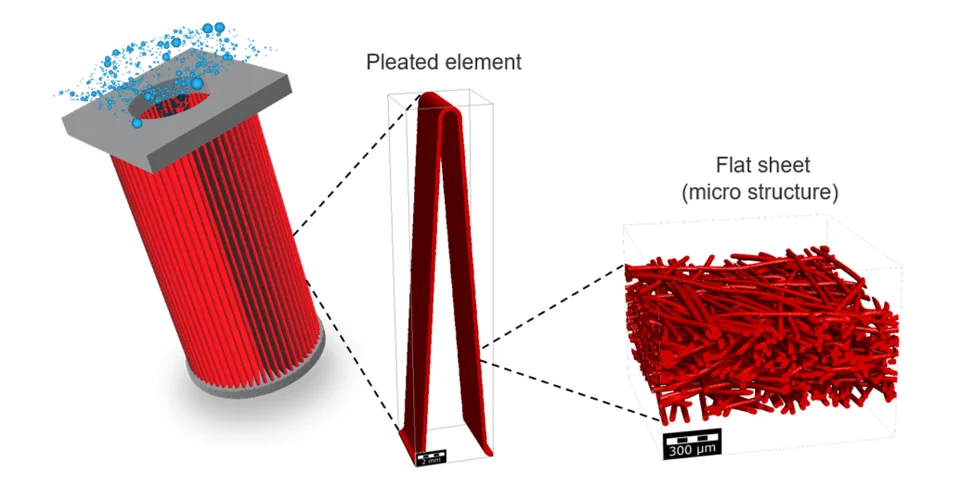
Several key parameters are essential as input data to precisely simulate the filtration characteristics of a filter element at macro scale, e.g. simulating the particle filtration through a pleated filter, as shown in the center in Fig. 1. Boundary conditions and flow conditions, as well as input parameters related to the micro-structure of the media, should be defined. The main input parameters for the macro-scale simulation, which are related to the micro-structure of the media, are: permeability of the media, maximum particle packing density and maximum flow resistivity for both the depth filtration regime and cake filtration regime (four parameters), and fractional filtration efficiencies. These parameters are routinely obtained by flat sheet experiments through the filter media. However, the GeoDict software, a pioneer modeling and simulation tool can be applied to obtain these input parameters, thus reducing the need for these time-consuming and costly experimental tests.
The study of the micro-structure of the filter media is the starting point to understand, analyze, and optimize a filter. The first simulation step on the media scale consists of processing of µ-CT images of the real media to prepare a detailed 3D micro-structure model of the filter media, as shown on the right side in Fig. 1.
Afterwards, the fluid flow through the filter media to obtain the permeability, followed by the transport of particles and the deposition of particles, are simulated with the FlowDict and FilterDict-Media modules [1]. The deposited particles through the depth filtration regime, determine the maximum particle packing density of depth filtration. The maximum flow resistivity for the depth filtration regime can be predicted as the flow resistivity of the clogged filter media minus flow resistivity of the clean filter media. The simulations provide all the specifics on deposition location and pressure drop over time. The maximum particle packing density and maximum flow resistivity for the cake filtration regime are obtained by running a pure cake filtration simulation with the same particle size distribution over a simple porous plate with an identical permeability as the real media [2].
For simulation of particles through the pleated filter at macro-scale, the particles are much smaller than the computational grid size. Therefore, when particles deposit, they do not fill the computational cell, but rather form a porous and permeable media inside and on top of the pleat. The FilterDict-Element module of GeoDict® allows user-defined control of how much a cell is filled, and how much resistivity to the flow the cell will have, depending on the degree of filling. Sub-voxel-sized particles form a filter cake, which is modeled as porous media with locally varying permeability. The simulation results are presented and discussed, such as pressure drop and deposited particles as a function of filtration time. Finally, the particulate flow simulation through the complete filter is animated, as shown on the left side in Fig. 1.
Speaker: Dipl.-Ing. Mehdi Azimian / Math2Market GmbH
References
[1] M. Azimian, C. Kühnle, A. Wiegmann, Design and optimization of fibrous filter media using life-time multi-pass simulations, Chemical Engineering & Technology 41, No. 5 (2018) 1-9. doi.org/10.1002/ceat.201700585
[2] J. Becker, L. Cheng, C. Kronsbein, A. Wiegmann, Simulation of cake filtration for polydisperse particles, Chemical Engineering & Technology 39 (2016) 559–566. doi.org/10.1002/ceat.201500350