Speaker: Caroline Willuhn, PhD Student, Battery Process Engineering / Institute for Particle Technology, Technical University of Braunschweig
Connecting Electrode Processing to Final Electrode Conductivity and Electrochemical Performance
Abstract
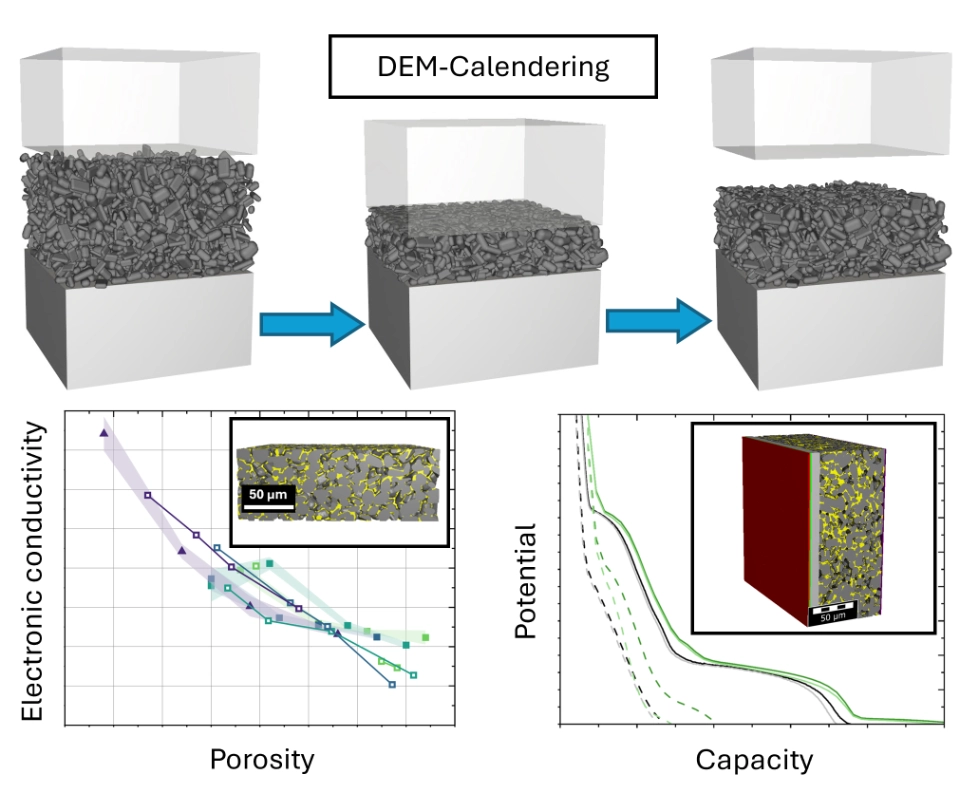
The microstructure of lithium-ion battery electrodes determines their electrochemical performance, and is strongly influenced by processing parameters. Especially the electrode compression step, called calendering, directly prior to integrating the electrode into the full battery, greatly alters the electrode microstructure. Calendering contributes to mechanical integrity of the electrode and enhanced energy densities as well as enables formation of continuous electronic pathways. However, it diminishes the possible ionic transport paths due to the reduction of pore space and limits fast charging capabilities. Thus, calendering process parameters must be carefully chosen to achieve optimal electrode performance. We have created a virtual workflow that couples discrete element method (DEM)-calendering, microstructure reconstruction, and electrode analysis to link electrode processing to structural and electrochemical properties.
This workflow is established for NMC-based cathodes, where first, our DEM-calendering model is validated against experimental calendering process results. Next, we reintegrate the carbon binder domain into the compressed particle pack using five reconstruction schemes. For each reconstructed microstructure, we compute pore size distributions, tortuosities, effective diffusivities, and electronic conductivities. The carbon binder domain-addition method that combines surface roughening of the active material with a realistic binder gradient within the electrode best reproduces experimentally measured transport properties. Lastly, we conduct electrochemical simulations across a range of C‐rates. These predict capacities that align well with those reported in literature, showing that our model can be used as the basis to detect diffusion-limiting C-rates. Overpotential analysis confirms that the Li‐ion transport, rather than electronic conduction, is the primary bottleneck. This suggests that micro-structure optimization in terms of improving ionic pathways is necessary for improving this electrode’s performance.
In a second step, this workflow is applied to graphite anode structures with different mass loadings, originating from previous drying simulations. The analysis is extended beyond electronic and ionic transport properties to include the electrochemical performance at different C-rates. Every stage of the workflow, from DEM-derived forces and elastic-plastic work during calendering to computed transport properties and electrochemical results, is validated against own experimental measurements of all mass loadings. We demonstrate that this virtual workflow accurately captures the impact of calendering across a broad range of anode mass loadings. This methodology offers a way of predicting and reverse-engineering electrode structure and performance, and can in the future be extended to other electrode compositions to identify bottlenecks for performance and guide the development of new battery electrodes.