Simulation of electrochemical impedance spectroscopy
GeoApp: Electrochemical Impedance Spectroscopy
Electrochemical Impedance Spectroscopy (EIS) is widely used to characterize electrochemical systems and is commonly applied in the experimental analysis of batteries or individual electrodes. With its 2026 release, GeoDict introduces the ability to simulate electrochemical impedance spectroscopy directly on microstructure-based battery and electrode models.
Unlike conventional approaches based on equivalent circuit models, GeoDict uses the same physics-based microstructure model for both impedance and charge simulations. This provides a more consistent representation of electrochemical behavior, helping users better interpret experimental EIS measurements and accurately parameterize charging simulations.
Battery and electrode microstructures can be created directly in GeoDict or imported from experimental µCT data. The EIS simulation functionality is currently available through expert settings, giving advanced users access to detailed impedance analysis withing the GeoDict environment.
The GeoApp Electrochemical Impedance Spectroscopy provides a convenient interface for defining the required expert settings and specifying the double-layer capacitances of the active materials directly within a dedicated dialog. Simulations can be performed either on the fully resolved microstructure model or on a homogenized P2D Newman model, depending on the desired level of detail and computational efficiency.
Once the parameters are defined, the GeoApp automatically starts the Electrochemical Impedance Spectroscopy simulation by executing the corresponding BatteryDict command. A GeoDict result file is generated containing the complete simulation data and analysis results.
For efficient evaluation and interpretation, the result file includes ready-to-use visualization of the impedance response, including Nyquist and Bode plots for the full cell as well as for the individual electrodes.
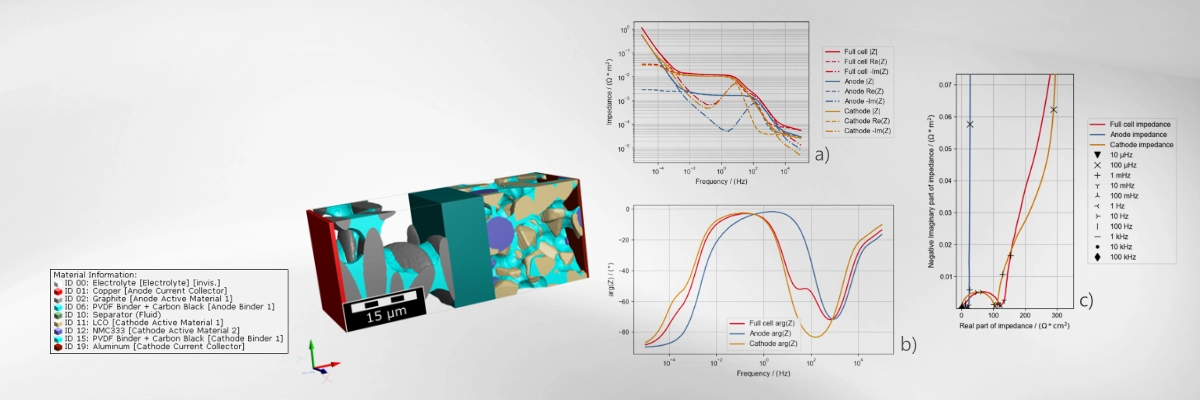
Simulation of electrochemical impedance spectroscopy of a Li-ion battery, Example 1
a) Bode plot for |Z|, Re(Z), Im(Z)
b) Bode plot for phase angle arg(Z)
c) Nyquist plot
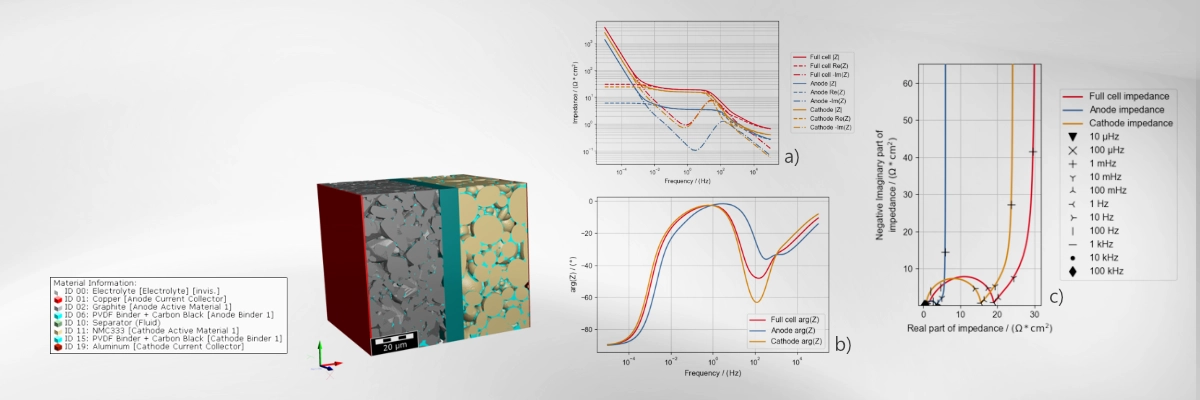
Simulation of electrochemical impedance spectroscopy of a Li-ion battery, Example 2
a) Bode plot for |Z|, Re(Z), Im(Z)
b) Bode plot for phase angle arg(Z)
c) Nyquist plot

Electrochemical Impedance Spectroscopy (EIS)
Modules and GeoApps that are often combined with the Electrochemical Impedance Spectroscopy GeoApp:
| Import & Image Processing | ImportGeo-Vol | |||
| Image Analysis | MatDict | PoroDict | ||
| Material Modeling | GrainGeo | Bimodal Anode & Bimodal Cathode | Generate Granular Twin from 2D | Generate Granular Twin from 3D |
| Simulation & Prediction | BatteryDict | BatteryDict-Degradation | ConductoDict | DiffuDict |