Generate Realistic All Solid State Battery Cathodes - Fast and Reliable
GeoApp: Solid State Battery Cathode Generation
Due to their high energy density and safety, all-solid state batteries (ASSBs) are strong candidates for the next generation of energy storage systems. Their performance is strongly influenced by the 3D microstructure of the electrodes that is difficult to access experimentally because it is sensitive to oxygen and humidity and even releases toxic gas. Digital generation of microstructures helps to overcome the challenge of finding suitable microstructures without the need of handling the material in the lab.
Using advanced stochastic geometric modeling, the GeoApp Solid State Battery Cathode Generation creates realistic cathode microstructures, consisting of active material, solid electrolyte and pore space. It uses an approach based on random fields with various correlation functions and offers an efficient alternative to classical particle packing methods:
- Allows precise control over solid volume fractions and wetting behavior of the materials.
- Enables large-scale parametric studies with realistic variability.
- Predefined parameters are customized for all-solid state battery cathode applications.
The outcome are physically meaningful, fully customizable 3D structures ready for virtual testing, image analysis and multi-physics simulations to virtually evaluate the influence of microstructure variation on the performance.
Suitable materials can be selected from the GeoDict Material Database.
This approach is not restricted to ASSB cathode generation. Similar approaches, customized for other structure types are available in the GeoApps Solid Oxide Electrode Generation and Catalyst Layer PEM Fuel Cell Generation.
GeoDict Publications
Marmet et al., Stochastic microstructure modeling of SOC electrodes based on a pluri-Gaussian method, Energy Adv., 2023, 2, 1942-1967, https://doi.org/10.1039/d3ya00332a
Marmet et. al.: Standardized microstructure characterization of SOC electrodes as a key element for Digital Materials Design, Energy Advances, 2023, volume 2, issue 7, pages 980-1013, doi.org/10.1039/d3ya00132f
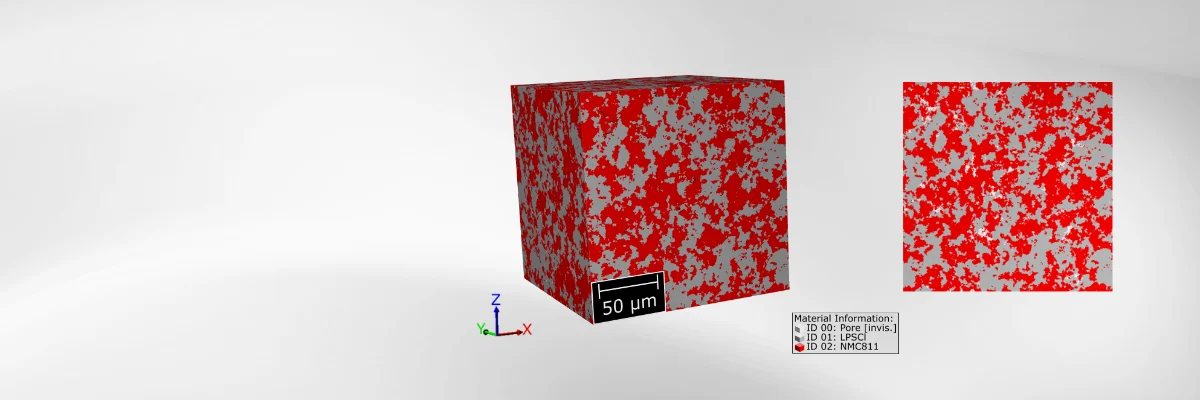
Solid State Battery Cathode Generation
- Example: Solid state battery cathode with volume percentages:
- Electrolyte: 44%
- Active Material: 53%
- Pores: 3%
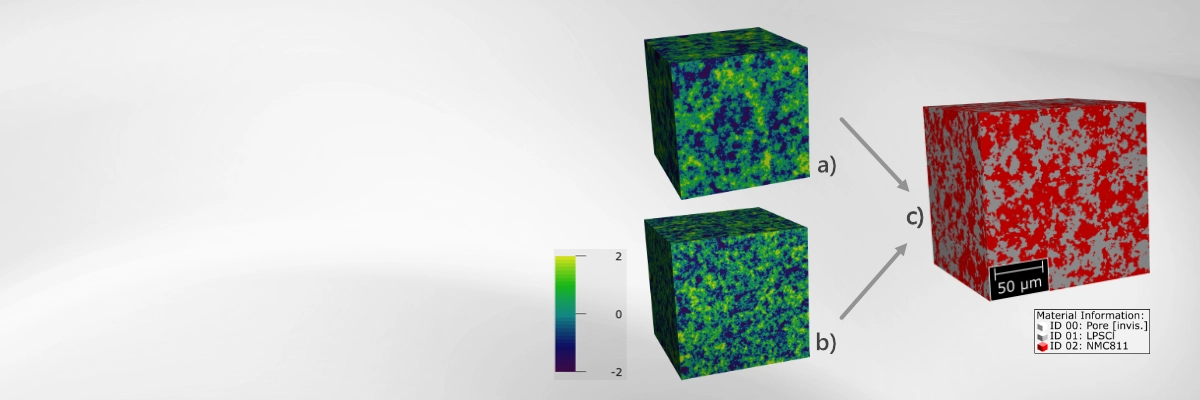
Structure generation based on random fields
- Stochastic geometric modeling for realistic three-phase
microstructures (2 solids + 1 pore phase) - Thresholding and phase control based on user-defined volume fractions
- Wetting behavior tuning through contact angle parameters
a) Random field 1 for solid phase 1, b) Random field 2 for solid phase 2,
c) Threshold operations
* H. Moussaoui et al., 2018, https://doi.org/10.1016/j.commatsci.2017.11.015
- Independent definition of solid volume percentage and typical particle size both for active material and solid electrolyte
- Tuning of wetting behavior through contact angle parameters
- Selection of different correlation functions for the Gaussian Random Fields
- Customized settings suitable for all-solid state battery cathodes available
- Options for smoothing the interface between active material, solid electrolyte and pore space.