Generate Realistic Catalyst Layer for PEM Fuel Cells
GeoApp: Catalyst Layer PEM Fuel Cell Generation
Catalyst Layers play a significant role for the performance of Proton Exchange Membrane (PEM) Fuel Cells. Their microstructure influences the electrochemical reactions as well as transport processes in the fuel cell. Due to the complex morphology of the microstructure, with nanoscale resolution, creating image data is very challenging, time intensive and expensive. Digital generation of microstructures helps to overcome this challenge.
The GeoApp Catalyst Layer PEM Fuel Cell Generation offers two different approaches to generate realistic catalyst layer microstructures, consisting of carbon, ionomer and pore space. One is a parametric approach, the other one uses advanced stochastic geometric modeling. Based on user-inputs- such as voxel resolution, layer dimensions, particle content, and ionomer fraction – the GeoApp generates realistic 3D catalyst layer geometries that capture the complex morphology.
The parametric approach enables the systematic creation and analysis of catalyst layer microstructures with particle packing methods, offering full control over their defining parameters.
With the advanced stochastic geometric modeling approach, the GeoApp generates realistic catalyst layer microstructures from Gaussian random fields. This approach offers an advanced alternative to particle packing methods. It allows additionally to control the wetting behavior of the materials and to use different correlation functions for generating the Gaussian random fields. The predefined parameters for the random fields and the thresholding are customized for catalyst layers of PEM fuel cells.
The outcome, with both approaches, are physically meaningful, fully customizable 3D structures ready for virtual testing, image analysis and multi-physics simulations to virtually evaluate the influence of microstructure variation on effective transport properties, including diffusivity, electrical conductivity and ionic conductivity. This allows targeted optimization towards one or multiple performance-relevant effective parameters.
Beyond microstructural analysis, the generated ensemble of catalyst layer structures serves as a robust basis for multiscale upscaling. The computed effective properties can be transferred to larger-scale models - from 1D and 2D representations up to full 3D simulations - enabling predictive assessment of fuel cell component and stack-level performance. In this way, the application bridges the gap between microstructure design and system-level optimization, supporting data-driven development of high-performance catalyst layers.
GeoDict Publications
Marmet et al., Stochastic microstructure modeling of SOC electrodes based on a pluri-Gaussian method, Energy Adv., 2023, 2, 1942-1967, https://doi.org/10.1039/d3ya00332a
Marmet et. al.: Standardized microstructure characterization of SOC electrodes as a key element for Digital Materials Design, Energy Advances, 2023, volume 2, issue 7, pages 980-1013, https://doi.org/10.1039/d3ya00132f
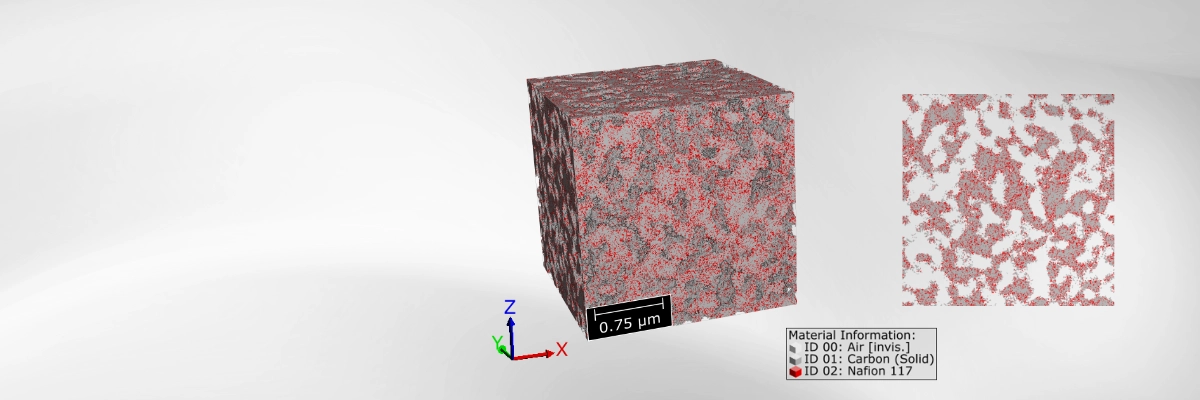
Catalyst Layer PEM Fuel Cell Generation with stochastic approach
Example: Catalyst Layer of a PEM fuel cell
with volume percentages:
- Carbon particles: 50 %
- Ionomer: 10 %
- Pore space: 40%
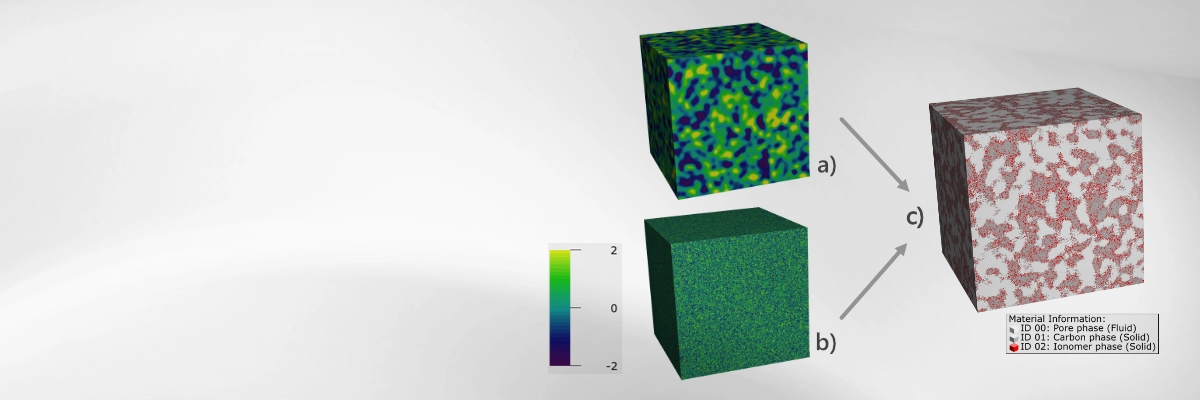
Structure generation based on random fields
- Stochastic geometric modeling for realistic
three-phase microstructures (2 solids + 1 pore phase) - Thresholding and phase control based on user-defined
volume fractions - Wetting behavior tuning through contact angle parameters
a) Random field 1 for pore space, b) Random field 2 for carbon phase,
c) Threshold operations
* H. Moussaoui et al., 2018, https://doi.org/10.1016/j.commatsci.2017.11.015
- Selection of parametric or advanced stochastic geometric modelling approach
- Independent definition of solid volume percentage for carbon particles and pores
- For stochastic approach:
- Tuning of wetting behavior through contact angle parameters
- Selection of different correlation functions for the Gaussian Random Field
- Customized settings suitable for catalyst layer for PEM Fuel Cells
- Options for smoothing the interface between carbon particles, ionomer and pore space.