Digital Modeling of weft- and warp-knitted Textiles
GeoApp: TexMath
In addition to woven textiles, weft- and warp-knitted fabrics are used in a wide range of specialized applications, including filtration, thermal insulation, and noise reduction in the automotive, process, and energy industries. Their complex mesh structures offers a high degree of design freedom, particularly through the extension of flat textiles into three-dimensional forms such as spacer fabrics.
Virtual textile design and simulation-based testing enable an efficient and resource-saving development process. As a result, the prototyping of technical weft- and warp-knitted fabrics becomes faster and more sustainable.
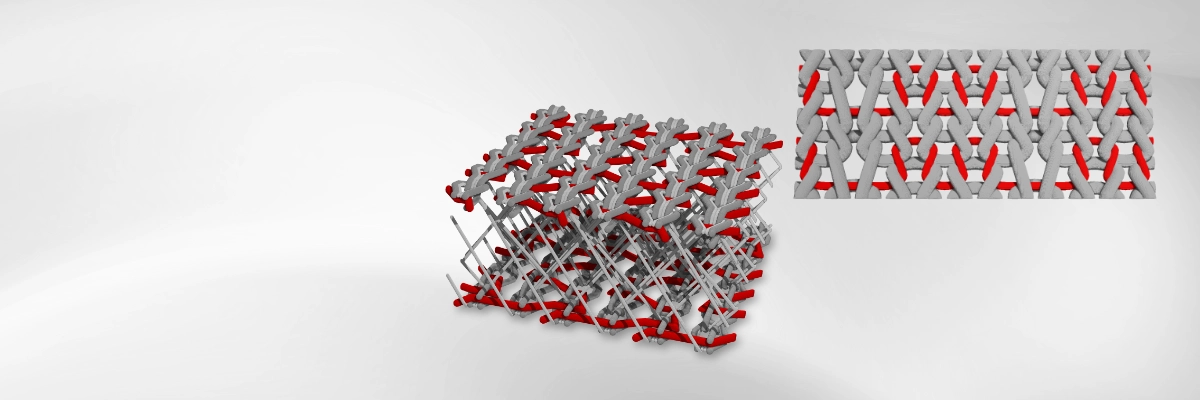
Generation of a weft- or warp-knitted Microstructure
- Description of the textile geometry
- Yarn diameters
- Count of rows per length
- Count of needles per length
- Layer distances
- Combination of different yarn materials.
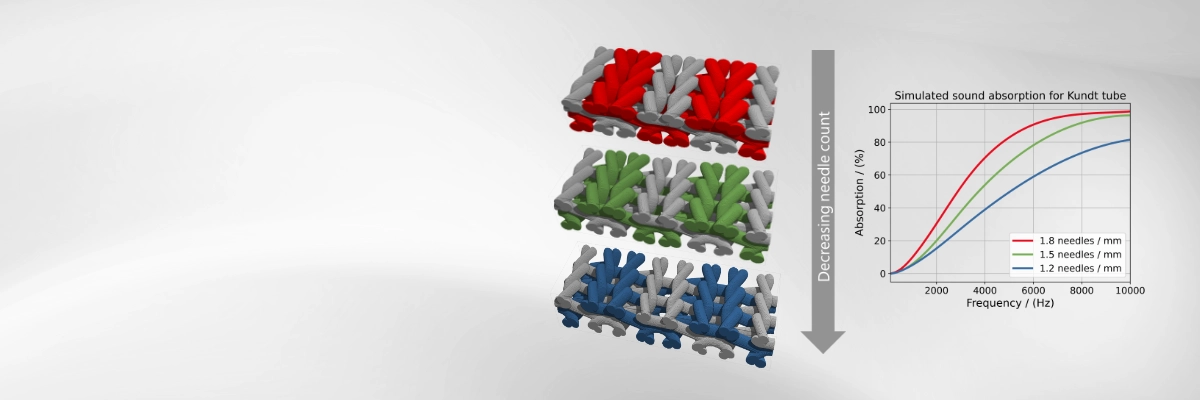
Acoustics: Geometry-dependent Sound Absorption Properties
- Noise reduction, e.g., in the automotive sector.
- Reproduction of Kundt's tube with multilayer knits.
- Optimization of knitting parameters for desired
sound absorption properties.
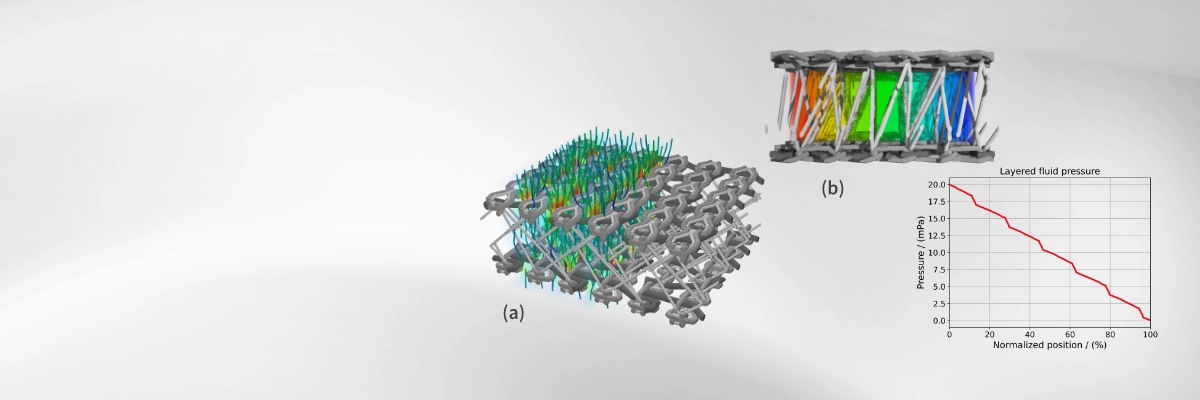
Filtration Properties and Air Permeability
- Analysis of textile microstructure porosity
- Impact of mesh density on filtration efficiency
- Virtual assessment of air flow through the
textile structure
(a) Air flow perpendicular to the textile plane
(b) Air flow between textile layers
GeoApp Features
Virtual microstructure generation
The TexMath GeoApp enables the generation of realistic microstructures for weft- and warp-knitted fabrics with desired dimensions and specifications. When combined with modules such as FilterDict, ConductoDict, or AcoustoDict, it allows the efficient calculation of the textile's filtration, insulation, and sound absorption properties, as well as targeted design optimization for specific applications, without the need for physical experiments.
In addition to the fabric pattern, a range of parameters can be defined for each textile type:
- Yarn diameters
- Count of rows per unit length
- Count of needles per unit length
- Layer spacing: for multilayered textiles (e.g. spacer fabrics), the distance between individual textile layers can be defined
The resulting periodic structures can be generated with any number of repetitions and at a user-defined resolution.
The TexMath GeoApp allows users to easily generate a wide range of weft- and warp-knitted textile microstructures by adjusting geometric parameters. The resulting geometries range from established flat knitted fabrics to innovative three-dimensional spacer fabrics.
This flexibility enables comprehensive, application-specific analysis and optimization of the microstructure of knitted textiles.
Outlook: Simulation of large deformations considering yarn-yarn contacts
Deformations in knitted structures are highly nonlinear. This behavior arises from the nonlinear force-strain response of the yarns and from substantial structural reorientation caused by the free sliding of yarns at contact points.
The mechanical solvers in TexMath support tensile, shear, and bending simulations of the generated knitted textile microstructures. A key feature of the underlying numerical methods is the explicit representation of sliding yarn-yarn contacts, combined with efficiency gains achieved through dimensional reduction techniques. This approach enables not only the simulation of textile mechanical behavior but also couplied analyses, such as fluid flow simulations in deformed configurations.
Mechanical simulations are already available in the external TexMath software and are planned for integration into future versions of the GeoApp.