Speaker: Dr. Jochen Zausch, Deputy Head of Department, Flow Processes / Fraunhofer ITWM, Dr. Ilona Glatt, Group Lead Electrochemistry / Math2Market GmbH
Speeding Li-ion Cell Wetting with Electrolyte Using Multiscale Simulations
Abstract
Electrolyte wetting of porous electrodes is a time-consuming and costly step in Li-ion cell production. In many manufacturing processes, cells are left to rest for extended periods to ensure complete electrolyte infiltration, yet the actual time required for full wetting is a priori unknown. Simply identifying the necessary wetting time could already reduce production duration by eliminating unnecessary waiting periods. However, determining this time experimentally is challenging, because wetting occurs inside complex, opaque porous electrode structures and is difficult to observe directly.
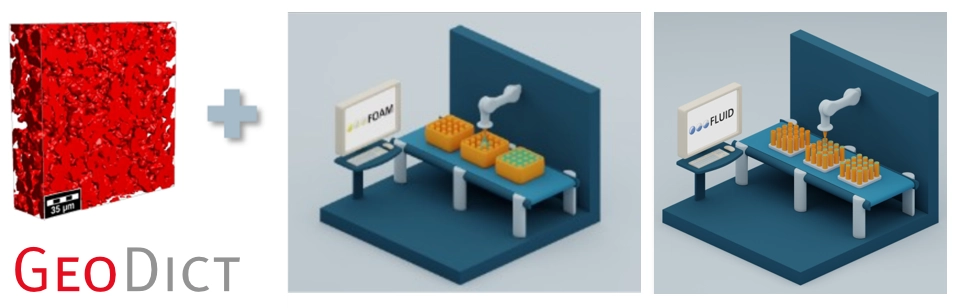
Simulation provides a powerful alternative for predicting electrolyte wetting behavior, which is mainly driven by capillary forces. With ITWM’s cell-scale simulation tool FLUID not only the duration for complete saturation can be predicted but also the time-development of the electrolyte distribution can be analyzed. Considering varying external pressures, the whole process design can even be optimized. For such simulations to be predictive, reliable input parameters are essential. GeoDict can be used to derive these parameters from realistic electrode microstructures, enabling the simulations to account for the true pore geometry and material-specific transport properties.
By combining GeoDict-based microstructure analysis with cell-scale wetting simulations in a multiscale approach, it is possible to estimate the necessary wetting time of a Li-ion cell with electrolyte and even improve on it by finding the optimum pressure profile for saturating an electrode depending on the microstructure. As a result, one of the most time-intensive steps in Li-ion cell production can potentially be shortened substantially, improving both process efficiency and manufacturing throughput.