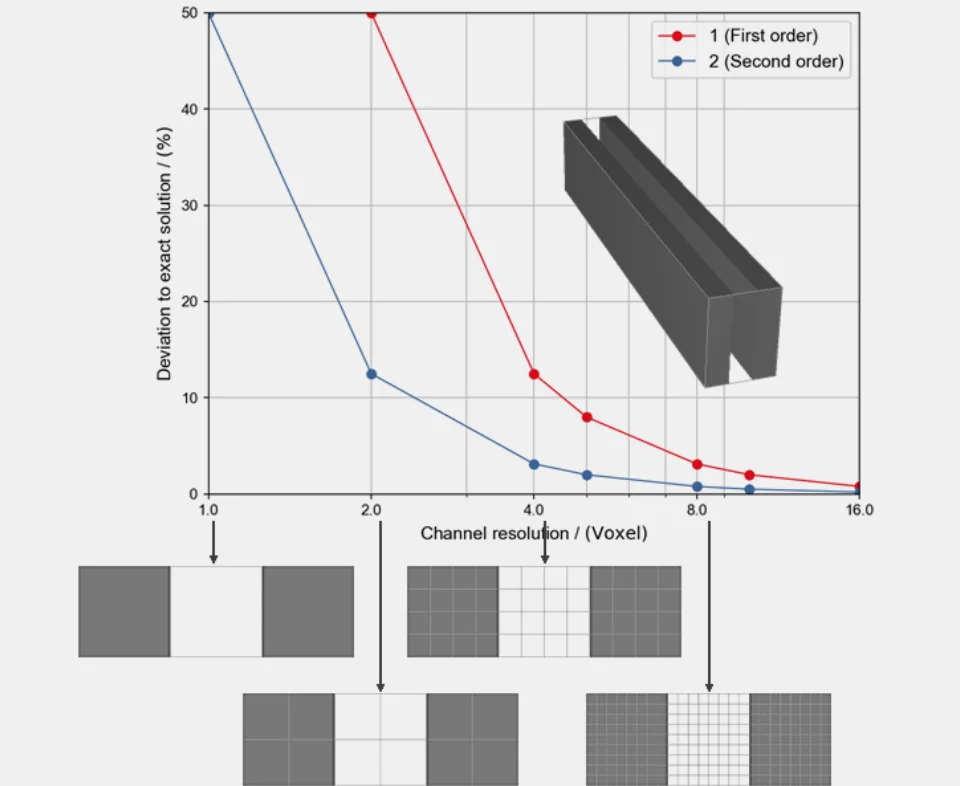
The analytical solution can be calculated from the simple expression d2/12 , with the channel width d = 10 µm. The permeability computed with the flow solver depends strongly on the discretization of the no-slip boundary conditions. The no-slip boundary condition is discretized in two different ways:
- First order discretization as described by Harlow-Welch (1965)1
- Second order discretization, which is included since GeoDict 2025.
A convergence study with increasing voxel resolution (from 1 to 16 voxel) shows that both discretization schemes approach the analytical permeability, with the second-order scheme converging significantly faster. Deviations below 2% are achieved with approximately 10 voxels for the first-order discretization and only 5 voxels for the second-order discretization.