Additive Manufacturing
GeoApp: Strut-Based Lattices
The Strut-Based Lattices GeoApp in GridGeo generates periodic 3D lattice structures with adjustable geometric parameters. These digital models support the design, simulation, and optimization of lightweight components in additive manufacturing.
Strut-based lattices are widely used as architected cellular materials because they combine low weight with favorable mechanical properties. Their stiffness-to-weight ratio and tailorable geometry make them suitable for applications such as lightweight components, mechanical metamaterials, energy absorption, biomedical implants, and heat exchangers.
The GeoApp generates periodic lattice structures based on predefined unit cells with nodes connected by straight struts. By repeating these unit cells in three dimensions, complex lattice geometries can be generated within seconds. The resulting digital models can be used directly for numerical simulations and virtual product development.
To support a wide range of engineering applications, the GeoApp offers 20 different lattice topologies based on established architectures described in the scientific literature. Users can generate lattice structures, adjust their geometric parameters, and use the resulting models directly in GeoDict simulation workflow.
The implemented lattice types are based on architectures described in the review article Architected Cellular Materials: A Review on Their Mechanical Properties Towards Fatigue-Tolerant Design and Fabrication by Benedetti et al. (2021) [1], providing a scientific basis for their use in engineering and research.
Reference
[1] M. Benedetti, A. du Plessis, R.O. Ritchie, M. Dallago, N. Razavi, F. Berto, Architected cellular materials: A review on their mechanical properties towards fatigue-tolerant design and fabrication, Materials Science and Engineering: R: Reports, 144 (2021), 100606, https://doi.org/10.1016/j.mser.2021.100606
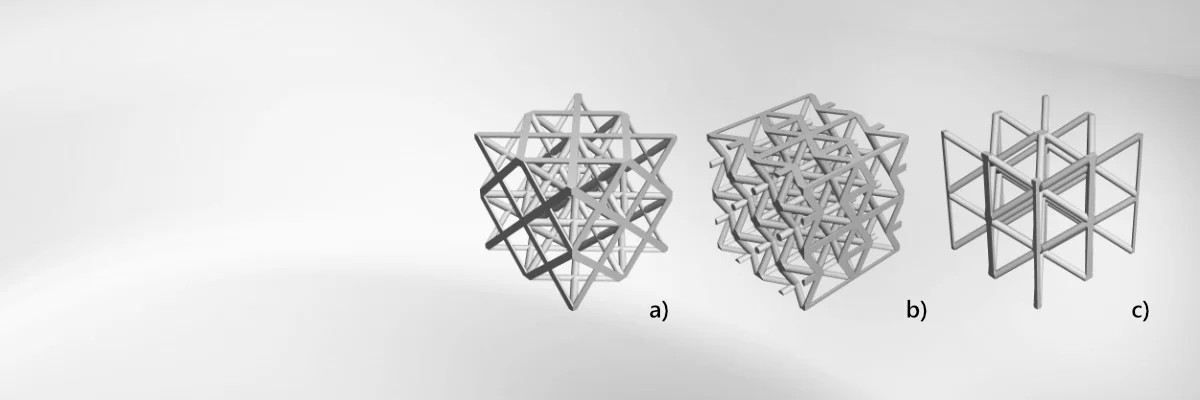
Strut-Based 3D Lattice Structures for Additive Manufacturing
- Generation of periodic microstructures
- Based on unit cells with nodes connected by
straight struts
a) All Face-Centered Cubic
b) Auxetic
c) Body-Centered Cubic with Z-Strut
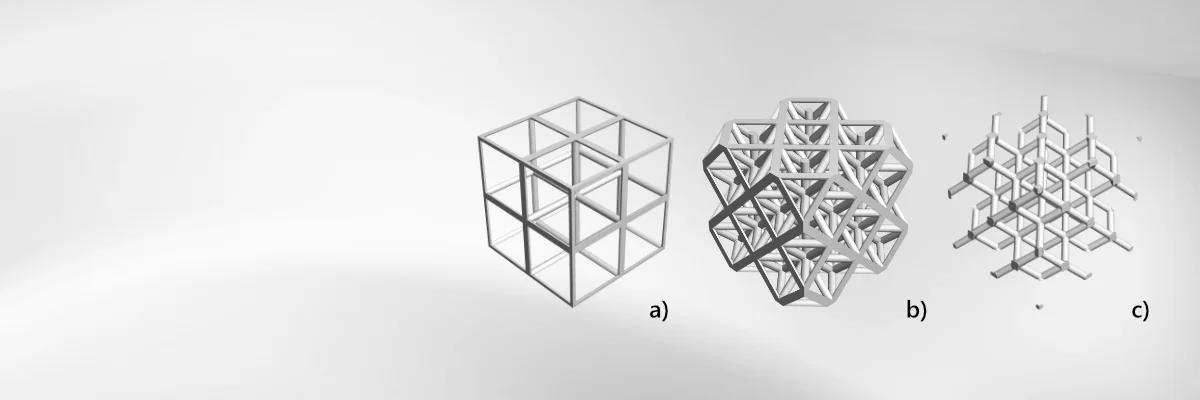
Strut-Based 3D Lattice Structures for Additive Manufacturing
- Parametric control of density, strut length,
and strut thickness - Suitable for lightweight structural design
a) Cubic
b) Cuboctahedron Z
c) Diamond Pentamode
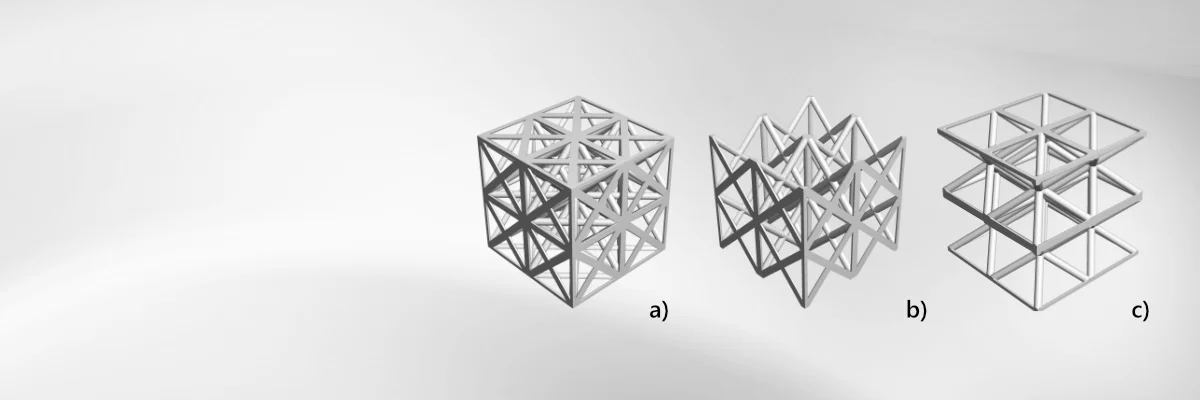
Strut-based 3D Lattice Structures for Additive Manufacturing
- Creation of 20 strut-based lattice structures
- Mechanical simulations for performance
evaluation (e.g., stiffness, strength, fatigue)
a) Face-Centered Cubic and Body-Centered Cubic
with X-, Y-, and Z-Struts
b) Face-Centered Cubic and Body-Centered Cubic with Z-Strut
c) Gyroid 7
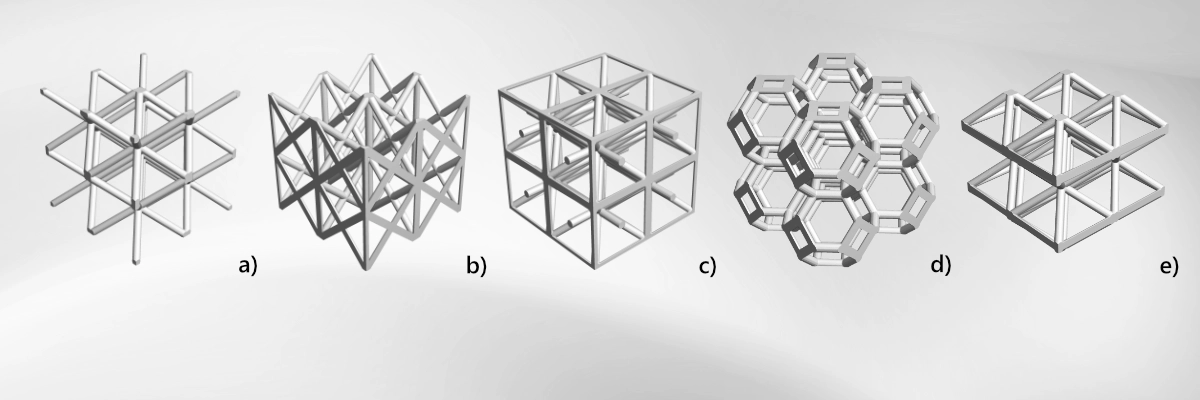
a) Body-Centered Cubic, b) Face-Centered Cubic with Z-Strut,
c) Iso-Truss, d) Kelvin Structure, e) Octahedron
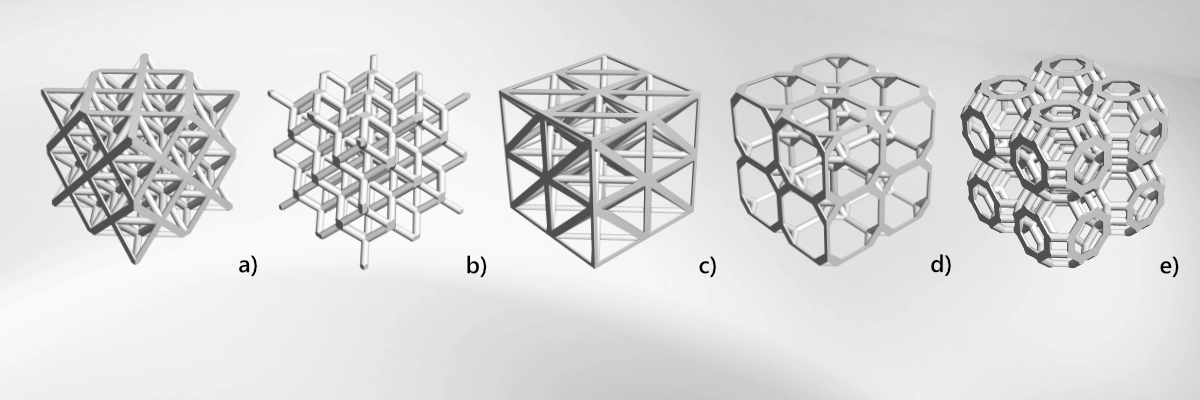
a) Octet-Truss, b) Rhombic Dodecahedron, c) Tetrahedron-Based,
d) Truncated Cube, e) Truncated Cuboctahedron
- Library of Lattice Architectures: Generate 20 strut-based lattice types based on established cellular architectures described in the scientific literature, covering a wide range of research and engineering applications.
- Parametric Geometry Customization: Adjust geometric parameters such as unit cell size, strut diameter, connection lengths, and relative density to tailor lattice structures to specific performance requirements.
- Digital Models for Additive Manufacturing: Generate digital 3D models of lattice structures for virtual product development, process optimization, and performance evaluation prior to manufacturing.
- Mechanical Performance Evaluation: Use GeoDict's simulation modules to predict stiffness, strength, deformation behavior, and fatigue performance of the generated lattice structures. Virtual testing can shorten development cycles and reduce the need for physical prototypes.
- Integrated GeoDict Workflow: Use the generated lattice structures directly in other GeoDict modules for mechanical, thermal, transport, and multiphysics simulations. This integrated workflow covers all steps from geometry generation to virtual material characterization.
Applications:
- Additive manufacturing
- Lightweight structures
- Mechanical metamaterials
- Biomedical implants
- Energy absorption
- Heat exchangers
- Research and materials development
