GeoApp Store: Flexible and efficient planning of material development processes with GeoApps
GeoDict is a versatile platform for material research, fully adaptable to specific needs, offering GeoApps. Whether a researcher, engineer, or industry professional, GeoApps are an easy way to extend and customize GeoDict, driving greater efficiency with optimized processes and tailored workflows. GeoApps are Python scripts, that use GeoPy and various Python libraries like NumPy and SciPy.
With the release of GeoDict 2025, the GeoApp portfolio in GeoDict has been significantly expanded. Individual GeoApps are available through the dedicated GeoApp Store on our website. The store also allows third-party developers to offer their GeoApps, utilizing GeoDict as a platform and using the full extend of GeoDict and GeoPy features.
GeoApp: Upscaling MICP
Upscaling MICP is an innovative GeoApp in GeoDict 2025 that extends the analysis of porous materials by upscaling Mercury Injection Capillary Pressure (MICP) curves from small-scale lab data to larger porous media models, such as digital rock and fuel cell data, overcoming traditional MICP limitations.
GeoApp: Generate Granular Statistical Digital Twin
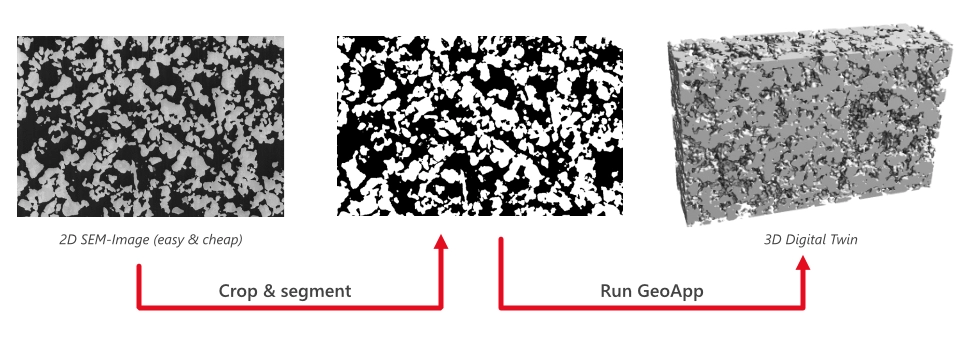
Generate Granular Statistical Digital Twin is a significantly enhanced GeoApp in GeoDict2025 for the automatic creation of a digital twin from a 3D, or even a 2D scan, of granular material. This GeoApp let's users calculate 3D properties - such as permeability - from inexpensive 2D images, including SEM scans.
GeoApp: FiberMath
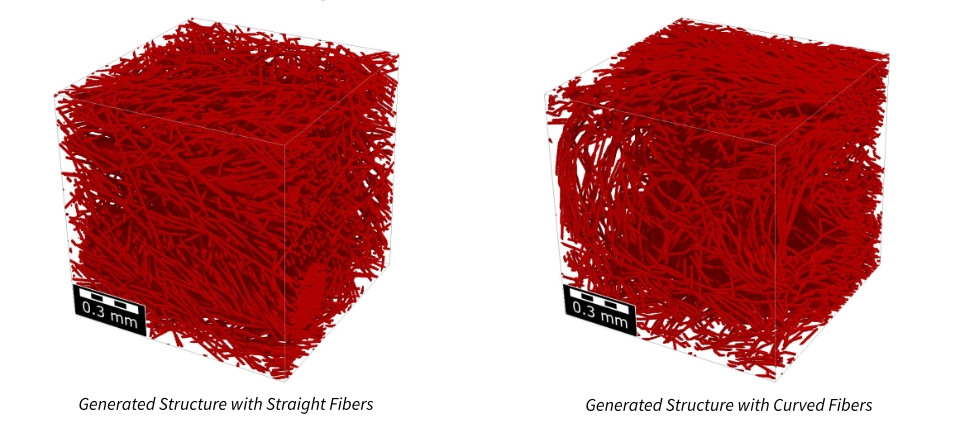
FiberMath is a GeoApp, originally developed by Fraunhofer-ITWM, for the creation of realistic microstructures of fiber-reinforced composites, enabling efficient computation of mechanical responses based on dense fiber geometry. The experimental characterization of fiber-reinforced composites is often expensive due to their local variability and anisotropy. Virtual testing mitigates these costs by supplementing limited physical measurements with computational analyses of virtually generated geometries. Accurate representation of micrometer-scale fiber microstructure - varying in type, orientation, length, curvature, and volume - is crucial for effective virtual testing and material optimization. While techniques like microcomputed tomography provide digital images, they cannot encompass the full range of fiber geometries, necessitating the use of synthetic digital twins. The FiberMath GeoApp supports multiple fiber types with customizable parameters and allows for configurations such as layered structures with planar-isotropic fiber orientation, typical in injection-molded components.