MechanoDict
Online seminar
Date
December 08, 2026
Time
04:00 pm - 05:00 pm (CET/CEST)
Event location
Online
Participant fee
Participation is free of cost but requires registration.
Additional
The online seminar will be held in English!
Understand large deformations in highly porous materials
Predicting the mechanical response of porous materials becomes challenging when compression changes their internal structure. Foam cells can buckle or collapse, fibers can rearrange, and new contacts can form. As a result, the stress–strain response may change substantially during deformation. Capturing these effects requires more than a linear-elastic simulation on the original geometry.
MechanoDict in GeoDict 2027 makes it possible to explore these effects directly on a material's three-dimensional microstructure. With the extended LIR solver, you can simulate large deformations, update the geometry as loading progresses, and capture newly formed contacts and their influence on the mechanical response. Designed with highly porous structures in mind, LIR combines advanced mechanics capabilities with efficient computation and low memory requirements.
Your contact person
Speaker

Sebastian Rief
Software Engineer
Add event to your calendar:
During this online seminar, you will discover how to:
- Analyze foam compression: Follow the deformation of a highly porous foam and understand effects such as cell collapse and increasing stiffness.
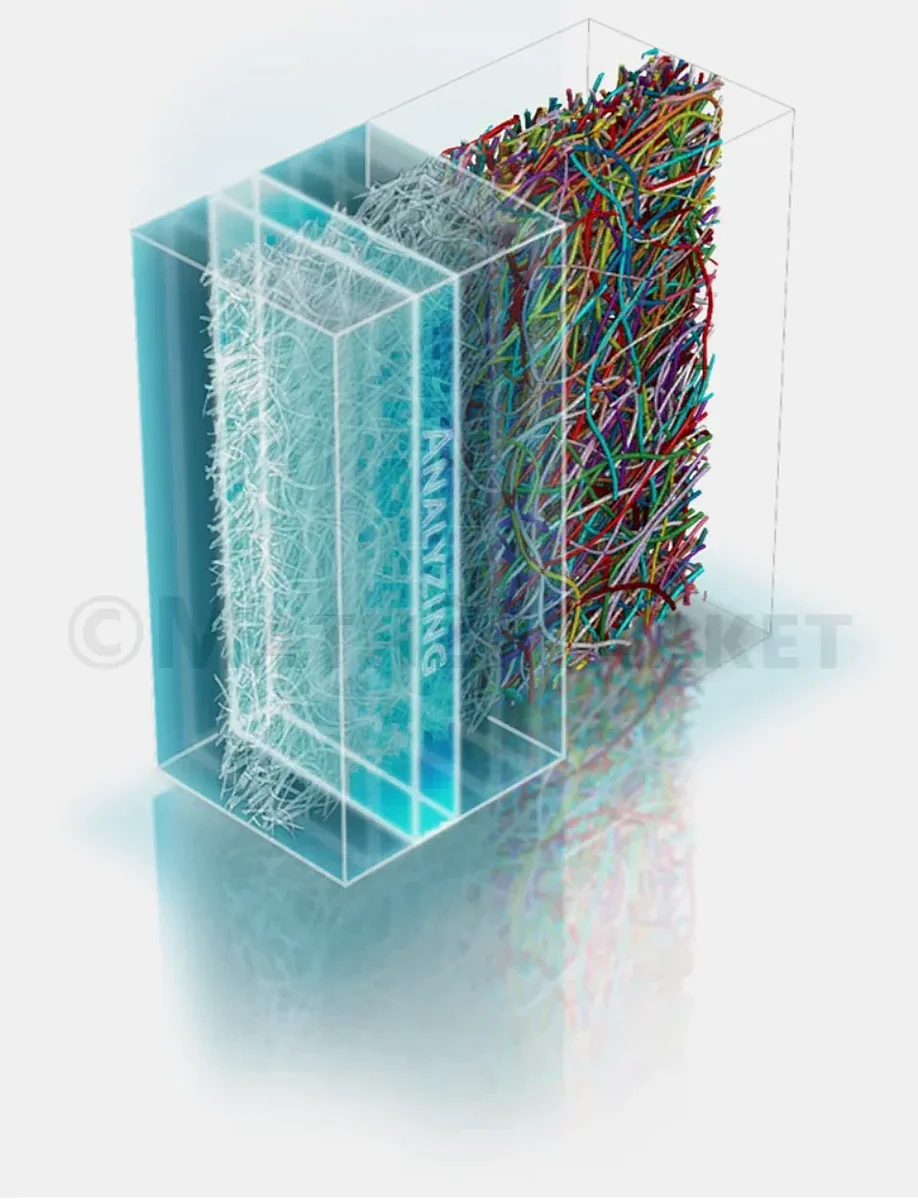
- Explore nonwoven behavior: Investigate how fibers rearrange and interact as a fibrous structure is compressed.
- Capture changing contacts: Use the *Calculate on Deformed Geometry* capability to update the microstructure between loading steps.
- Represent realistic material behavior: Go beyond linear elasticity with nonlinear models for plasticity, damage, and viscoelasticity.
- Set up and interpret simulations: Learn about loading conditions, stress–strain curves, and the large-deformation workflow in a live demonstration.

Why should you attend this seminar?
- Understand material behavior: Connect changes in microstructure to macroscopic compression response.
- Go beyond small-deformation assumptions: Investigate contact formation and structural rearrangement under substantial loading.
- Work with realistic porous geometries: See examples based on foam and nonwoven structures.
- Benefit from efficient simulation: Learn why the LIR solver is attractive for large, highly porous models.
- See GeoDict in action: Experience the workflow during a live demonstration
Whether you already use GeoDict or are evaluating simulation tools for material development, this seminar will show how microstructure-based large-deformation analysis can contribute to a better understanding of porous materials.