Validation of Structure Generation and Navier–Stokes Flow Simulation for Hierarchical Microsieves
Validiation: GridGeo und FlowDict
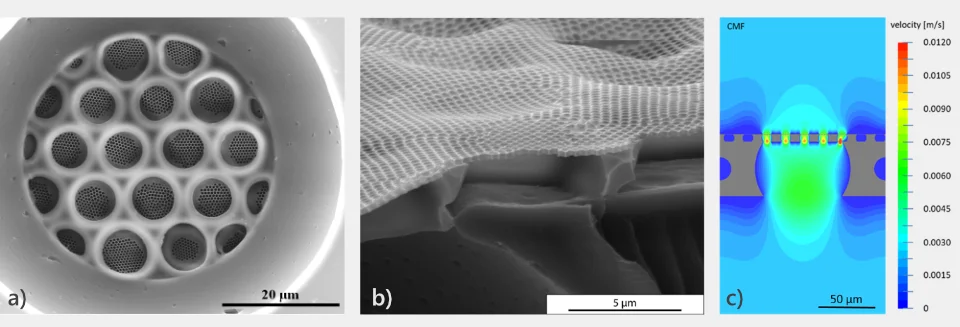
The validation of GeoDict simulations for hierarchical microsieves was performed by comparing virtually generated structures and corresponding Navier–Stokes flow simulations with experimental data reported by Buchsbaum et al. (2021). The investigated microsieves were produced by float-casting and consist of three hierarchically stacked layers with different pore sizes: a coarse layer with approximately 68 µm pores, a middle layer with approximately 7 µm pores, and a fine layer with approximately 0.24 µm pores (see Fig. 1a and 1b).
This layered structure provides a challenging validation case because the flow resistance is governed by the combined influence of pores on very different length scales.
Model Micro-Sieve Structures with GridGeo
Using GridGeo, the hierarchical microsieve structure was generated virtually by reproducing the three-layer arrangement of the experimental samples. The generated model includes the coarse, middle, and fine sieve layers and was used as the basis for subsequent flow simulations. This validates the structure-generation workflow by demonstrating that GridGeo can create geometrically representative models of complex, layered microsieve systems suitable for predictive simulation. A side view of the modelled geometry can be seen in Fig. 1c.
Simulate Flow and Compare Measurements
Based on the generated microsieve structures, Navier–Stokes simulations were performed in GeoDict to compute the flow through the different sieve configurations (flow field shown in Fig. 1c). The simulated permeances were compared directly with the corresponding experimental measurements from Buchsbaum et al.
For the coarse layer C, the simulated permeance was 1.05 × 10⁻⁶ m, compared to an experimental value of (0.9 ± 0.2) × 10-6 m. For the combined coarse and middle structure CM, the simulation yielded 5.93 × 10⁻⁸ m, in close agreement with the measured value of (5.5 ± 0.7) × 10-8 m. For the full hierarchical structure CMF the simulated permeance was 2.76 × 10⁻⁹ m, compared to the experimental value of (2.8 ± 0.2) × 10-9 m.
Validate the GeoDict Workflow
The very close agreement between simulated and experimental permeances confirms that GeoDict accurately predicts the flow resistance of hierarchical microsieves across multiple structural configurations. In particular, the successful prediction of the full CMF structure demonstrates that the combined GridGeo and FlowDict workflow can capture the relevant geometric and hydrodynamic effects in complex, multilayer microsieve systems.
The validation therefore shows that GeoDict provides a reliable virtual workflow for generating realistic microsieve structures and predicting their flow performance, supporting its use for the design and optimization of advanced filtration and separation media.
References
Buchsbaum, J., Ranis, S., Angelow, K., Linden, S., Tegenkamp, C., & Goedel, W. A. (2021). Hierarchically Structured Microsieves Produced via Float-Casting. Langmuir, 37, 2040–2055. doi.org/10.1021/acs.langmuir.0c02936
