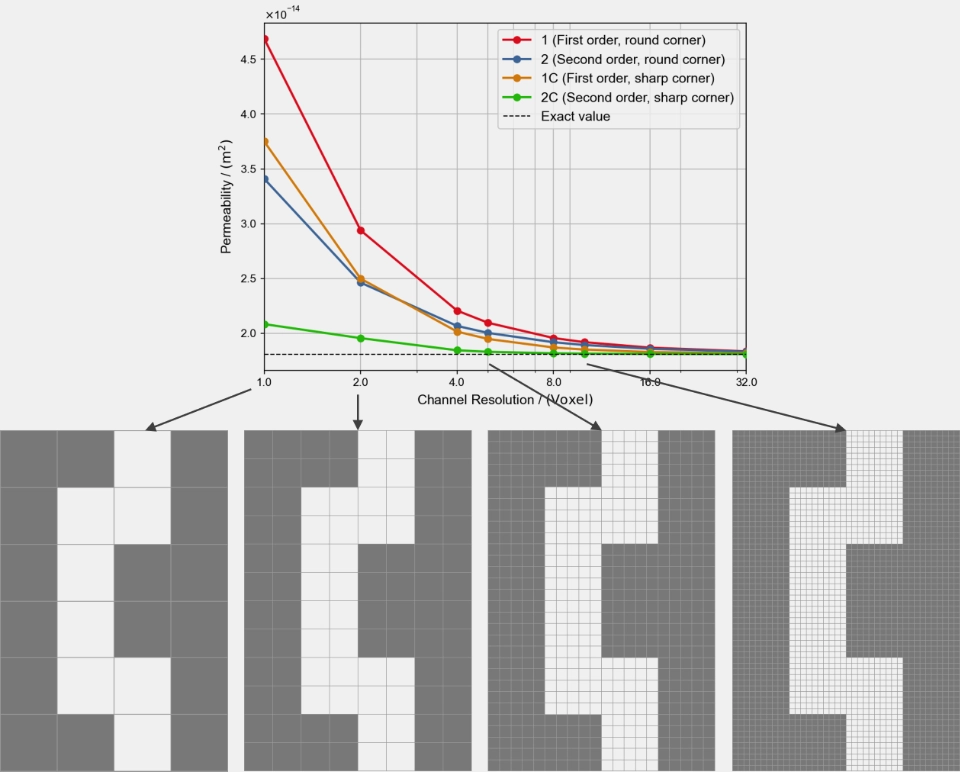
The permeability computed with the flow solver depends strongly on the discretization of the no-slip boundary conditions. They can be discretized in different ways:
- First order discretization as described by Harlow-Welch (1965)1
- Second order discretization, which is included since GeoDict 2025.
- Additionally, for both discretizations, no-slip is enforced at the voxel corners (“Sharp corner”)
A convergence study with increasing voxel resolution of the pore channel (from 1 to 32 voxel) shows that all numerical solutions approach the same permeability. Moreover, when using second order discretization or the sharp corner option, the same accuracy is reached at a coarser resolution. This effect is increased when using both options together, which allows to enlarge the field of view while maintaining the computational costs.