Validation: Flow, Filter Efficiency and Electrostatic Effects in Complex Filter Media
Validation of simulations with FilterDict and FlowDict
As part of the ElekSim project, GeoDict filtration simulations were rigorously validated in collaboration with the Institut für Umwelt & Energie, Technik & Analytik e.V. (IUTA).
By comparing simulation results with experimental data from filter media featuring different geometries, fiber structures, and dimensions, the study confirmed the high predictive accuracy of GeoDict for realistic filtration applications.

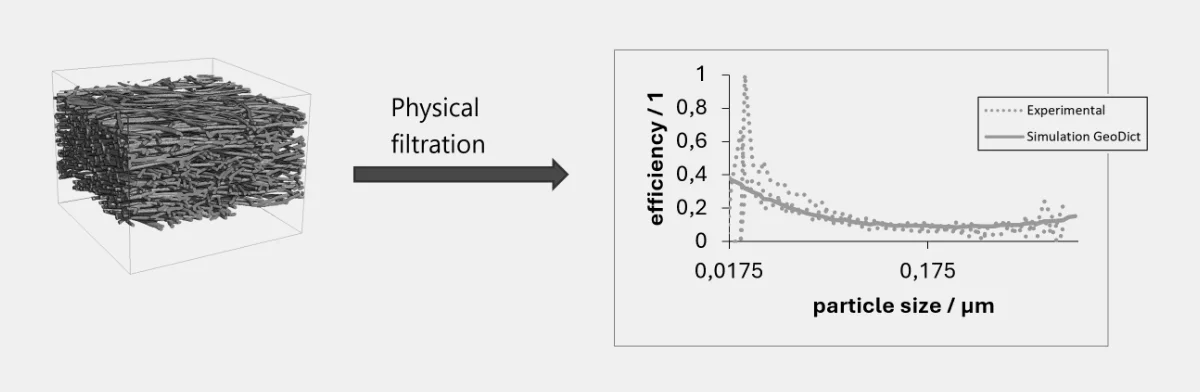
The validation presented here focuses on Filter Medium A, one of five commercial filter media investigated within the ElekSim project. The filter medium was reconstructed from high-resolution µCT scans using AI-assisted image segmentation, resulting in a detailed three-dimensional digital representation of the real microstructure. Figure 1 shows the reconstructed geometry used for the simulations.
As a first validation step, the airflow through the reconstructed filter was simulated by solving the Navier–Stokes–Brinkman equations. The predicted pressure drop (or air permeability) was compared with experimental measurements to verify that the digital model accurately represents the real filter structure. For Sample A, the experimentally measured air permeability at 200 Pa was 1300 ± 250 l/(m²·s), while the GeoDict simulation predicted 1510 l/(m²·s), demonstrating excellent agreement between simulation and experiment and confirming the accuracy of the reconstructed geometry.
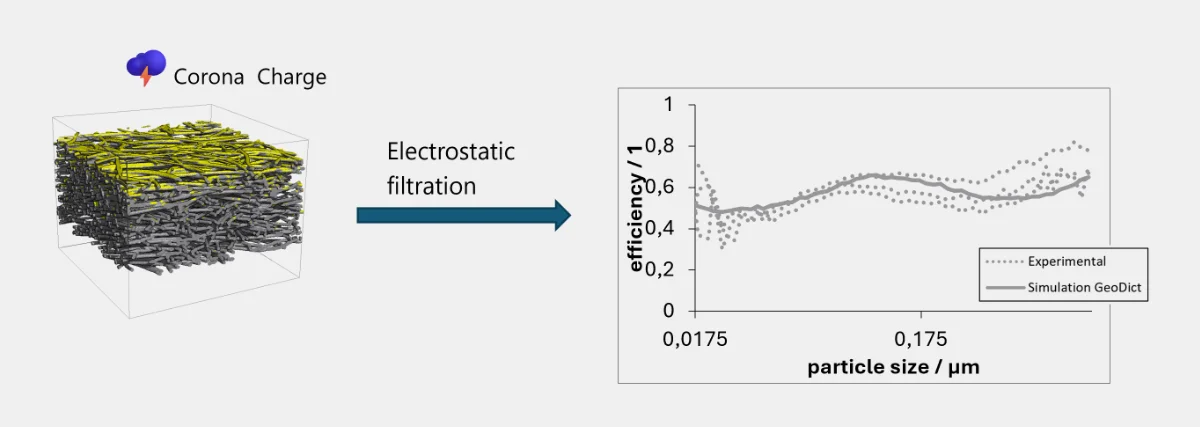
After validating the flow field, particle filtration simulations were performed across the full particle size range. First, purely mechanical filtration was simulated by removing all electrostatic charges from the fibers, corresponding to the experimentally discharged filter media. GeoDict accurately reproduced the measured filtration efficiency, including the characteristic minimum filtration efficiency at the Most Penetrating Particle Size (MPPS) (see Figure 1). Subsequently, electrostatic effects were incorporated by assigning realistic charge distributions to the fibers and accounting for electrophoretic and dielectrophoretic particle interactions. The predicted total filtration efficiencies for the charged filter media showed similarly close agreement with the experimental measurements, successfully reproducing the characteristic shape of electret filter efficiency curves (see Figure 2).
The close agreement between simulation and experiment for both airflow resistance and filtration efficiency demonstrates that GeoDict reliably captures the governing mechanical and electrostatic particle capture mechanisms.
The successful validation across multiple filter media with different fiber materials, geometries, and charging methods confirms the robustness of the modeling approach and highlights GeoDict as a predictive tool for the virtual design, optimization, and development of advanced filtration media.