Validation of Minkowski parameters in GeoDict
Validiation: MatDict und PoroDict
Minkowski parameters describe the volume, surface area, curvature and topology of a material structure. For 3D microstructures, these quantities provide compact measures of phase fractions, interfacial area and interface shape. The Euler characteristic summarizes the balance of connected components, tunnels and enclosed cavities. Together, these descriptors help compare reconstructed and generated structures, track morphological changes during processing, and investigate relationships between microstructure and material properties. We tested their computation in GeoDict against analytical solutions for simple geometries. The results confirm the tested boundary conventions and topological measures, and quantify how voxel resolution and shape affect accuracy.
Geometries and boundary conditions
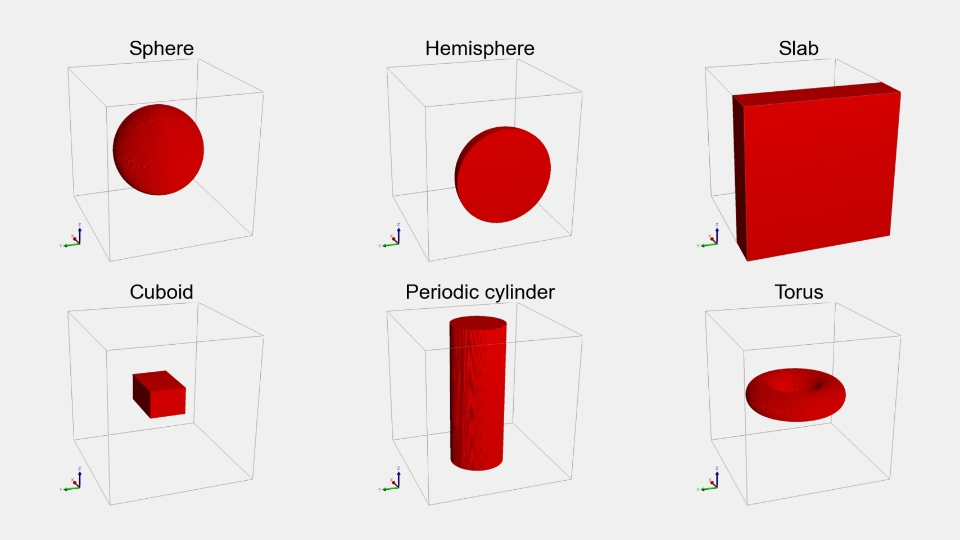
The benchmark comprises 12 configurations on 64³, 128³, 256³ and 512³ grids in a fixed cubic domain. It includes centered and wrapped spheres, a cropped hemisphere, quarter-sphere and octant, slabs, a cuboid, a periodic cylinder and a torus. Periodic and symmetric boundaries are compared for the centered sphere, wrapped sphere and slab. Figure 1 shows six representative geometries.
Each result is compared with the analytical value for the same boundary convention. For example, symmetric cuts retain one half, one quarter or one eighth of the full sphere contribution; the cut planes add no caps or rims. The corresponding Euler values are boundary-weighted fractions, rather than the Euler characteristic of an isolated capped solid. Periodic continuation gives the slab two interfaces and the cylinder no end caps.
We compare volume, surface area, integrated mean and Gaussian curvature, and Euler characteristics for both 6- and 26-connectivity. Relative errors are expressed as a percentage of the analytical value; zero references are assessed by absolute error. Specific quantities are checked by normalization with the domain volume.
Accuracy and interpretation
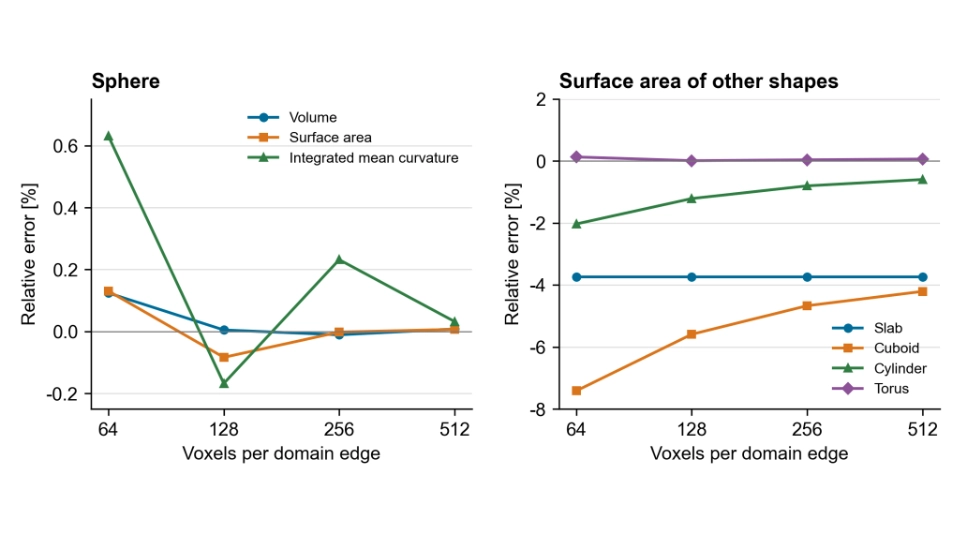
For the centered sphere at 512³ voxels, the errors are +0.008% in volume, +0.007% in surface area and +0.032% in integrated mean curvature. Centered and wrapped sphere results agree, and the symmetric cuts retain the expected fractions. Both Euler definitions match their references throughout the benchmark. The periodic cylinder and torus have zero integrated Gaussian curvature and zero Euler characteristic, as expected.
Two effects explain differences from the analytical geometry. Voxelization changes the sampled boundary and introduces errors that vary with resolution. In addition, the estimator uses 13 fixed directions, so its angular sampling produces an orientation bias that does not disappear simply by refining the grid. Integral and digital geometry provide the methodological background for these measurements [1].
The slab illustrates this distinction: its surface area remains 3.741% below the analytical value at every tested resolution, although its planar boundary is aligned with the voxel grid. The cuboid area error decreases in magnitude to −4.206% at 512³. Integrated mean curvature retains errors of −7.337% for the periodic cylinder and −1.949% for the torus.
Together, the analytical comparisons test boundary handling, topology, normalization and the expected estimator behavior. They support the implementation for the tested cases while showing why accuracy for spherical particles does not imply the same accuracy for planar, edged or directionally aligned structures.