What is 3D Image Processing?
created by Anton Du Plessis, Ph. D.
3D image processing describes the transformation of raw volumetric data into clean, structured, and usable digital images. It is a foundational step in digital material analysis and simulation workflows, because all subsequent evaluations depend directly on the quality of the processed image data.
Unlike 2D images, 3D datasets consist of voxels, which can be understood as three-dimensional pixels. Each voxel represents a small volume element and stores information such as grey value or material contrast. These voxel-based datasets are typically generated by imaging techniques like computed tomography (CT) and focussed ion beam scanning electron microscopy (FIB-SEM), amongst others.
How 3D Data Is Acquired (CT, Microscopy, Scanners)
3D image data is commonly acquired using X-ray computed tomography (CT), focused ion beam scanning electron microscopy (FIB-SEM), and other volumetric scanning techniques. Each method produces datasets with different resolutions, contrasts, and artifacts, depending on the material, scan parameters, and physical limitations of the imaging system.
At a high level, all these techniques reconstruct a 3D volume from a large number of measurements. The resulting image quality is influenced by factors such as:
- Spatial resolution
- Signal-to-noise ratio
- Contrast between material phases
- Reconstruction algorithms
A key principle applies across all acquisition methods: image quality determines result quality. If important microstructural features are not captured clearly during acquisition, no amount of post-processing can fully recover them. Image processing therefore builds on acquisition quality and aims to stabilize, correct, and enhance the data within these physical limits.
The 3D Image Processing Workflow (Before Analysis)
Before any quantitative analysis, segmentation, or simulation can be performed, a structured image processing workflow is required. This workflow focuses on preparing the dataset, not interpreting it yet.
Typical goals at this stage include:
- Focusing the dataset on the relevant region of interest (e.g. cropping)
- Ensuring geometric consistency (e.g. slice alignment, tilt correction)
- Normalizing grey values (e.g. contrasting)
- Reducing noise and artifacts (e.g. smoothing)
This preparation phase is critical because later analysis steps assume that the image data is already clean, aligned, and representative of the underlying material structure.
Image Pre-Processing
Image pre-processing addresses basic structural and numerical issues in the dataset.
Common operations include:
- Cropping
Removing irrelevant regions reduces data size and ensures that only the material region of interest is analyzed. This also improves computational efficiency. - Registration
Aligning multiple volumes into a common coordinate system is essential when combining datasets or comparing time-dependent measurements. It is also typical to align objects with flat surfaces to the viewing coordinate system for easier slice-to-slice viewing. Also relevant here is image alignment and tilt correction for FIB-SEM datasets. - Downsampling
Reducing resolution in a controlled manner can balance detail and computational cost, especially for large volumes. - Grey-value normalization
Standardizing intensity ranges improves comparability and stability for subsequent processing steps.
These operations do not change the physical meaning of the data but make it manageable and consistent.
Filtering & Image Enhancement
Filtering, de-noising and image enhancement focus on improving signal quality while preserving relevant structural details.
Typical filtering approaches include:
- Median and Gaussian filtering for smoothing
- Non-local means filtering to reduce noise while maintaining edges
- Many other smoothing operations are possible, at different levels of smoothing
In addition, AI-based denoising methods are increasingly used to distinguish noise from meaningful structural information, especially in low-contrast or low-dose scans.
Specific artifact-removal applicable to CT data and FIB-SEM data are also relevant here, including:
- CT ring artifact removal
- FIB-SEM curtaining artifact removal
Filtering plays a crucial role because it directly affects later steps such as segmentation. Clean, well-filtered images enable more stable thresholding, fewer classification errors, and more reliable quantitative results. On the other hand, important features may be lost and corners or edges smoothed too much if excessive smoothing is applied. The amount of filtering required often depends on the type of image and its quality.
Why Careful Image Processing Is Critical for Reliable Results
The impact of careful image processing is often underestimated. Errors introduced at this stage are rarely corrected later and instead propagate through the entire workflow.
A simple rule applies:
Bad images lead to bad numbers — and bad numbers lead to wrong decisions.
Inaccurate image processing can result in:
- Incorrect volume fractions
- Distorted geometrical features
- Misinterpreted connectivity or porosity
- Unreliable simulation inputs
High-quality image processing is therefore not optional. It is a prerequisite for trustworthy material characterization and engineering decisions.
How GeoDict Supports 3D Image Processing
GeoDict provides a comprehensive set of tools specifically designed for 3D image processing of material data. These tools support the full preparation workflow, from raw 3D scan data import to analysis-ready volumes.
Key capabilities include:
- Advanced pre-processing functions such as cropping, registration, and resampling
- A wide range of filtering and denoising methods
- Interactive visualization during processing with previews
- Dedicated filters and corrections for CT and FIBSEM datasets
- All image processing steps can be automated
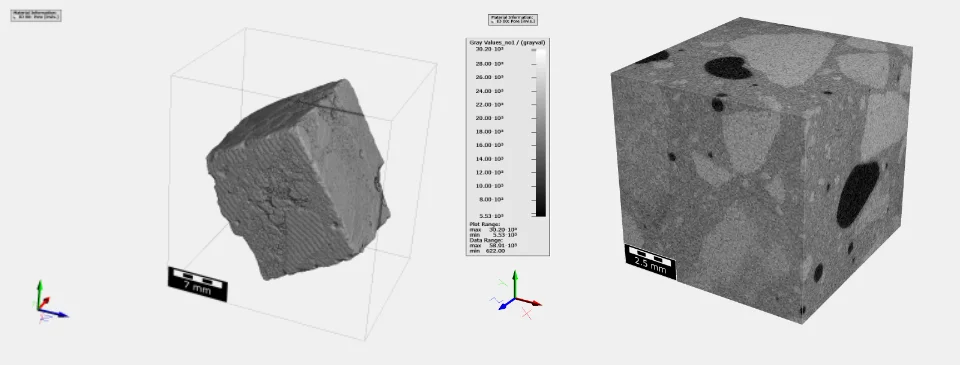
![[Translate to English:] De-Noising before and after](/fileadmin/CONTENT_files/News/Blog/Keywords/Image-Processing-Fig.2.webp "Fig. 2")
The focus at this stage is strictly on image preparation. GeoDict enables users to systematically clean and enhance their 3D datasets before moving on to segmentation, material characterization, or simulation modules. This step is fully performed in a dedicated “3D Image Processing” dialog, that guides the user and provides all options available for careful image processing. This is part of the “ImportGeoVol” module of GeoDict, and the full documentation for this module is available at: https://www.math2market.com/fileadmin/UserGuide/GeoDict2024/ImportGeoVol2024.pdf
Are you interested in exploring 3D image processing and digital material development with GeoDict? Math2Market offers a free trial license that allows you to test the software’s features and experience its workflow firsthand.
To request your trial license or learn more about GeoDict’s features, visit the page
Conclusion: Image Processing Is the Foundation
3D image processing is not visualization and not interpretation. It is the technical foundation that enables everything that follows.
By transforming acquired raw 3D scan data into clean, consistent, and reliable 3D images, image processing ensures that subsequent measurements, analyses and simulations are based on sound data. Without this step, even the most advanced material models cannot deliver meaningful results.
In digital material development and advanced 3D materials characterization, everything starts with image processing.
