What Is Image Segmentation?
created by Anton Du Plessis, Ph. D.
Image segmentation is the process of assigning labels to voxels in a 3D image so that different materials, phases, or structural features can be distinguished from one another. Each 3D pixel or voxel is classified as belonging to a specific class, such as solid material, pore space, fiber, particle, or defect.
In simple terms, segmentation answers the question:
What is what inside the image?
While image processing prepares and cleans the raw 3D scan data, segmentation adds semantic meaning to the image. Only after segmentation does a 3D dataset become suitable for quantitative evaluation, such as measuring porosity, particle size distributions, connectivity, or transport properties.
Why Segmentation Is So Important
The accuracy of the segmentation directly determines measurement accuracy. All numerical results extracted from a 3D image (e.g. volumes, surfaces, distances, or simulation outputs) are based on the segmented representation of the material.
Even small segmentation errors can lead to:
- Incorrect phase fraction measurements
- Distorted geometrical features and quantitative evaluations
- Misinterpreted connectivity analyses or
- Unreliable simulation results
Because segmentation defines which voxels belong to which phase, it represents the most critical step for obtaining accurate and reproducible quantitative results. Errors introduced here cannot be corrected later by post-processing or simulation.
Common Segmentation Methods Explained Simply
There is no single segmentation method that works best for all materials and datasets. Different approaches are suited to different image qualities, material systems, and analysis goals. In practice, segmentation workflows often combine several methods. Some general concepts that hold true are the following:
- Global methods based on thresholding are often a good first step, and fastest
- Checking the segmentation relative to underlying grey-value images in 2D is common
- Use of morphological filters are often used for cleaning up segmentations
Manual Segmentation
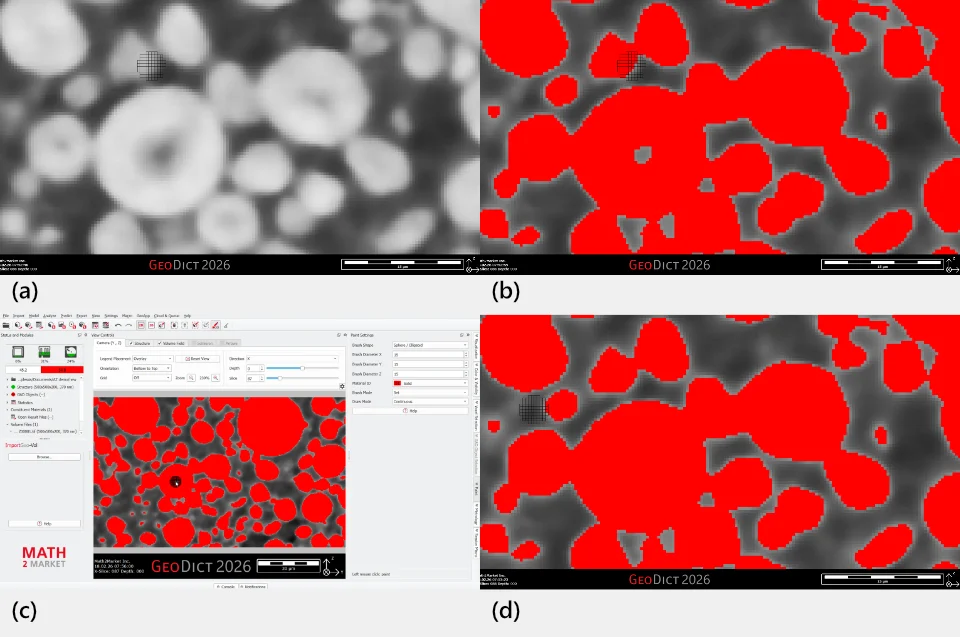
Manual segmentation involves assigning voxel labels directly by user interaction. This is typically done by painting or correcting regions slice by slice.
Advantages
- High level of control
- Useful for complex or ambiguous regions
Limitations
- Time-consuming
- Limited reproducibility
- Not feasible for large datasets
Manual segmentation is mainly used for small regions, or for refinement/correction of global threshold segmentations.
Threshold-Based Segmentation
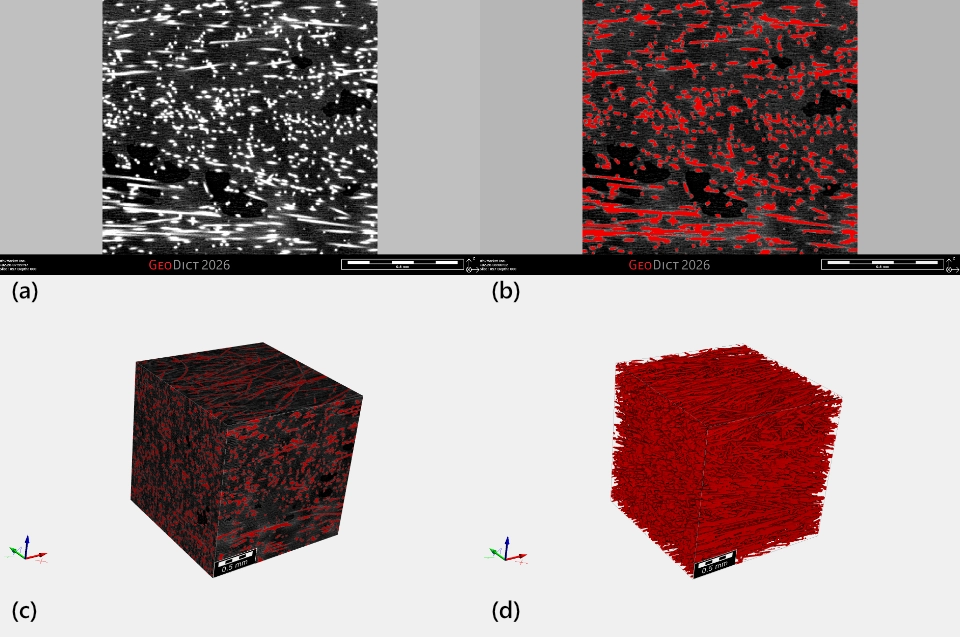
Threshold-based segmentation classifies voxels based on their grey values. A threshold separates voxels into different phases according to intensity ranges.
This approach is often explained using a grey-value histogram, where peaks correspond to different materials. Voxels are assigned to phases by selecting ranges within this histogram.
Advantages
- Simple and fast
- Effective for high-contrast images
- Can be automated with algorithms such as Otsu’s method
Limitations
- Sensitive to noise
- Difficult for overlapping grey values
Thresholding is widely used when phases are clearly distinguishable in the image.
Connectivity-Based Segmentation
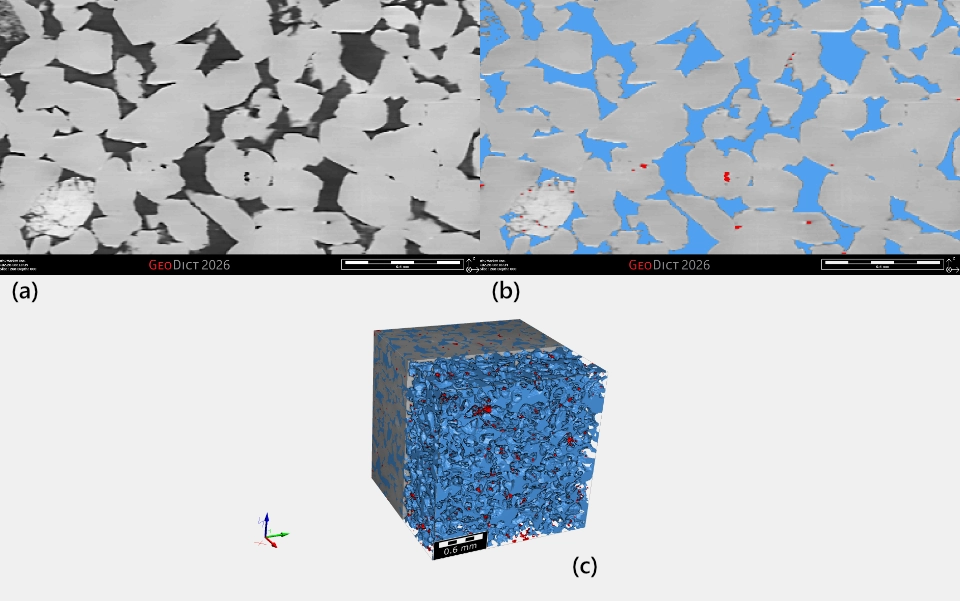
Connectivity-based segmentation uses the spatial relationship between voxels. Voxels are grouped together if they are neighbors and share similar properties. Here neighbors refers mostly to connectivity in 3D.
A simple analogy is filling connected regions with paint: once a starting voxel is selected, all neighboring voxels that meet certain criteria are included.
Advantages
- Captures connected structures
- Useful for pores, cracks, tunnels, channels or networks/branched structures
Limitations
- Sensitive to noise and interruptions
- Often requires pre-filtering
This method is particularly relevant for analyzing connected phases, or for segmenting one part of an image to check its 3D extent.
Morphological Operations
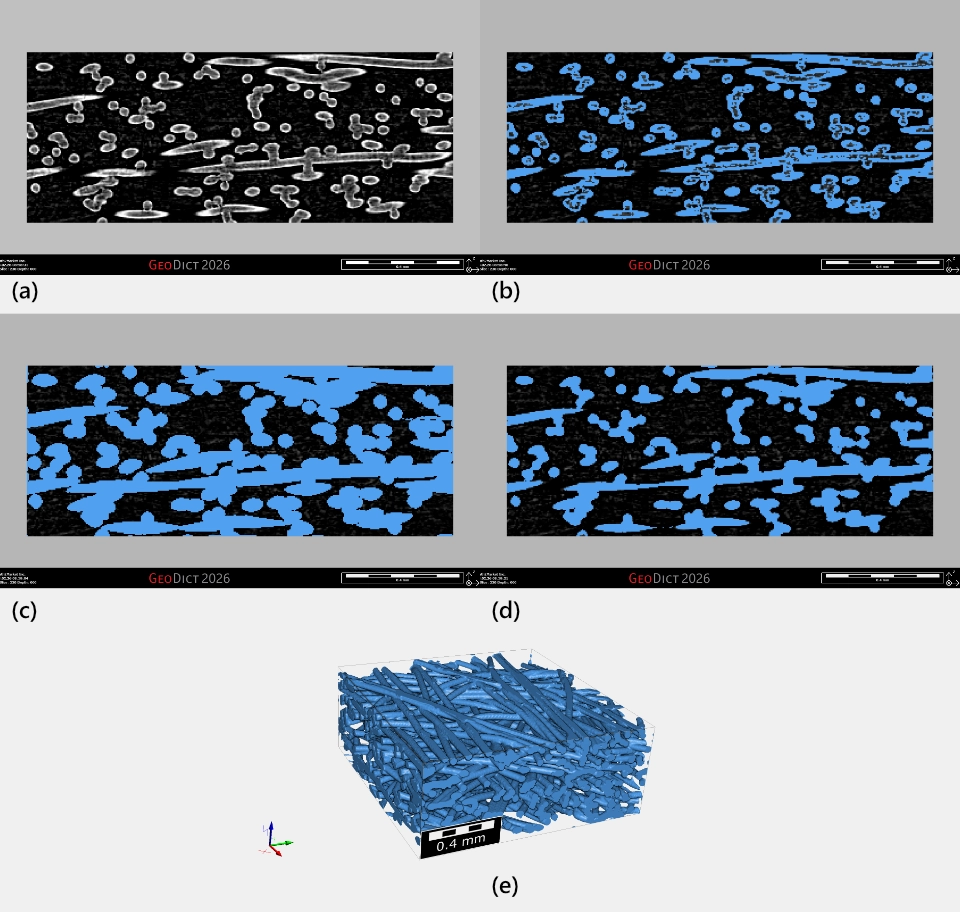
Morphological segmentation applies operations such as erosion and dilation to refine segmented structures.
Intuitively:
- Erosion “erodes” away from the boundary of an existing segmented feature, making the segmented region smaller
- Dilation “dilates” an existing segmented region, extending the segmented region, making it larger
- Combinations of erode and dilate can be used to keep existing boundaries while removing small isolated features (opening) or filling gaps or holes and smoothing boundaries (closing)
Advantages
- Improves shape consistency
- Fast and practical
- Useful for cleanup after initial segmentation
Limitations
- Can alter geometrical details if overused
Morphological methods are typically used as supporting steps rather than standalone solutions. Related steps include opening and closing that are combinations of erode and dilate.
Feature-Based Segmentation
Feature-based segmentation relies on local geometric or textural characteristics rather than grey values alone. Examples include orientation, shape, or local neighborhood statistics.
This approach is well suited for:
- Fibrous materials
- Granular structures
- Porous media with complex geometry
Advantages
- Captures structural information
- Effective for heterogeneous materials
Limitations
- More complex parameterization
- Higher computational effort
Feature-based methods are essential when intensity information alone is insufficient.
AI-Based Segmentation
AI-based segmentation uses trained models to classify voxels based on previously learned patterns (encoded into trained models). These methods are particularly effective for low-contrast images, complex microstructures and any image data where traditional segmentation fails, e.g. due to artifacts.
Advantages
- Handles subtle differences
- Reduces manual intervention
Limitations
- Requires training data
- Model quality depends on representativeness
- Can be time-consuming
AI-based approaches are increasingly used when conventional methods reach their limits.
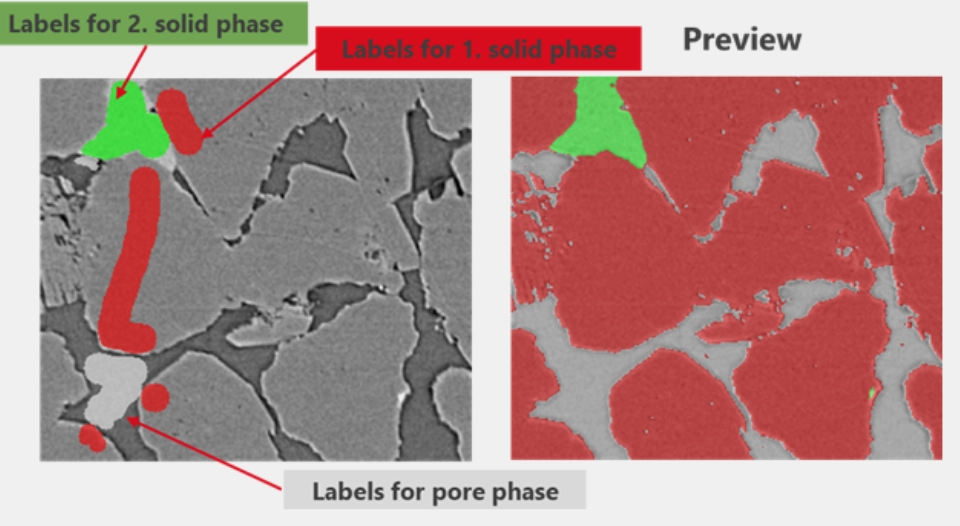
How to Choose the Right Segmentation Method
Selecting an appropriate segmentation strategy depends on several factors:
- Image quality
Noise level, contrast, and resolution strongly influence method suitability. - Number of phases
More phases increase complexity and often require combined approaches. - Required accuracy
High-precision measurements demand more robust and carefully validated segmentation. - Time vs. automation trade-off
Manual methods offer control but are slow, while automated methods scale better but require careful initial setup and testing.
In practice, segmentation is often an iterative process, combining multiple methods and validation steps.
How GeoDict Helps with 3D Segmentation
GeoDict provides a comprehensive set of 3D segmentation tools tailored to material datasets. These tools support both manual and automated workflows, allowing users to adapt their approach to the specific material and image quality.
Key capabilities include:
- Threshold-based and feature-based segmentation methods
- Connectivity and morphological operations for refinement
- Interactive tools for manual correction and validation
- Fast AI-based segmentation tools
- The most advanced deep learning Unet options that use full 3D information
- Dedicated AI-segmentation modules for fibers and grains
By combining a wide variety of segmentation tools with interactive user feedback, GeoDict supports reliable and reproducible segmentation workflows for a wide range of material systems. This step is fully performed in a dedicated “Segmentation and Labelling” dialog, a part of the image processing workflow, that guides the user and provides all options available for careful segmentation. This is part of the ImportGeo-Vol module of GeoDict. Additionally, built-in AI-based segmentation is found in the modules GrainFind and FiberFind.
Math2Market offers a free trial license that allows you to test the software’s capabilities and experience its workflow first-hand.
To request your trial license or learn more about GeoDict’s features, visit our page
Conclusion: Good Segmentation = Good Engineering Numbers
Image segmentation transforms images into measurable material representations. It defines the basis for every quantitative result derived from 3D image data.
Accurate segmentation leads to reliable numbers.
Poor segmentation leads to misleading conclusions.
For engineering decisions based on 3D image data, good segmentation is not optional—it is essential.
