GeoDict – A digital Material Laboratory for Composites
Abstract
Introduction: Fiber-reinforced composites have revolutionized lightweight applications across industries like automotive and aerospace. Short and long fiber-reinforced thermoplastics have become increasingly popular and are renowned for cost-efficiency, effective production processes like injection molding, and robust mechanical properties. However, these composites possess intricate microstructures characterized by two material phases (fibers and polymers) and often unwanted pores. The manufacturing process further complicates the microstructure by affecting factors like fiber orientation and length distribution. This presentation comprises two parts, each highlighting the invaluable role of GeoDict as a digital material laboratory for composites, both in analysis and optimization of these composite materials.
Part 1: Microstructure Analysis of Glass Fiber-Reinforced polymers
In the first part, we delve into the analysis of a glass fiber-reinforced polypropylene specimen produced by the Leibniz-Institut für Verbundwerkstoffe GmbH (IVW). This material boasts a fiber volume content of 13%, a tensile modulus of 6 GPa, and an elongation at break of 2.5%. GeoDict plays a pivotal role in this study, offering a comprehensive toolkit for material analysis. The key steps involved segmentation, fiber analysis, pore identification, and mechanical property analysis, all conducted seamlessly within GeoDict.
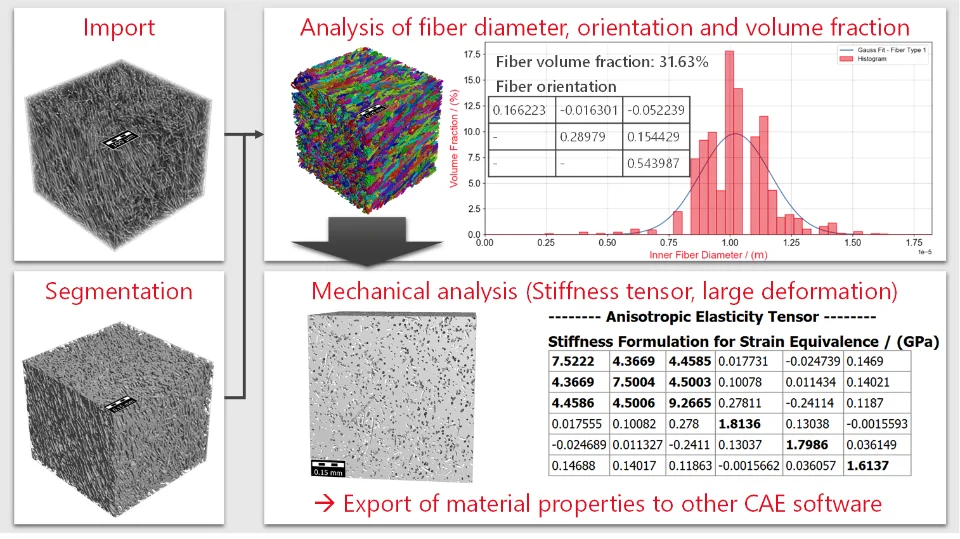
The presentation demonstrates how GeoDict effectively unravels complex fiber orientations, pore characteristics, and mechanical properties in injection-molded materials. The software's capabilities are used to provide valuable insights into microstructural intricacies and provide material and process developers with optimization opportunities and robust quality control methods.
Part 2: Efficient Permeability Determination in Glass Fiber Textiles
In the second part, we shift our focus to the efficient determination of permeability in glass fiber textiles, exemplified by a unidirectional glass fiber fabric (Hacotech G300U 1270). GeoDict introduces a groundbreaking workflow that minimizes the extensive experimental tests typically required for permeability determination. This innovative approach begins with micro-scale modeling, where individual fibers, each with a diameter of a few micrometers, are represented in a three-dimensional model. Subsequently, mesoscale modeling of the fabric with solid rovings follows, aided by GeoDict's versatile capabilities.
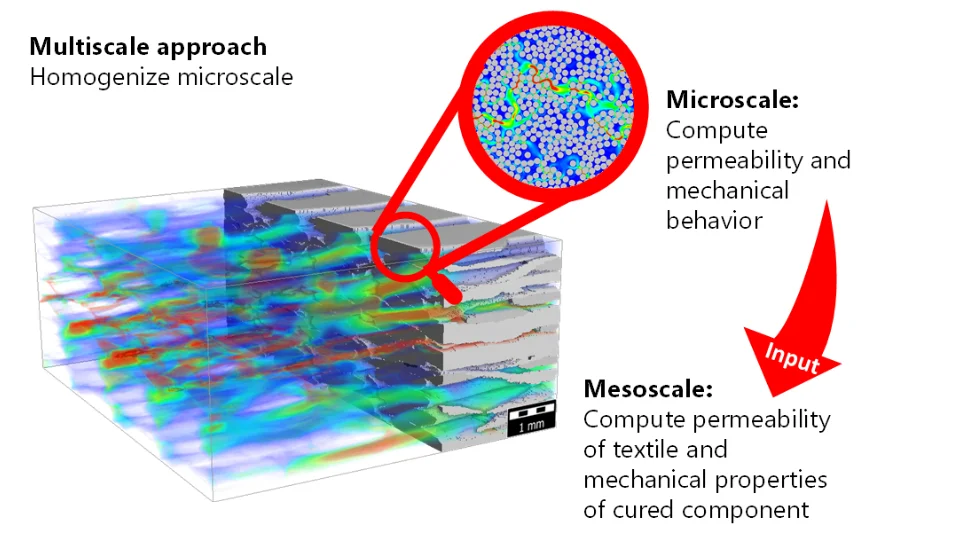
The presentation showcases GeoDict's utility in predicting permeability and mechanical properties of composite materials, thereby significantly reducing development times and costs. It highlights the software's adaptability to the challenges posed by different textile parameters and complex fabric structures. By offering accurate predictions, GeoDict enables engineers to expedite material development and analysis, paving the way for more efficient composite applications.
Conclusion: GeoDict emerges as an indispensable ally for researchers and professionals working with fiber-reinforced composites. In the presentation, it becomes evident that GeoDict provides an in-depth understanding of complex microstructures, shedding light on fiber orientations and pore characteristics in injection-molded materials. These insights are instrumental for optimizing composite materials, ultimately enhancing their performance in real-world applications.
The second part extends GeoDict's utility to the realm of permeability determination in glass fiber textiles, illustrating its potential to revolutionize material analysis. By minimizing the need for resource-intensive experimental tests, GeoDict streamlines the development process and reduces costs significantly. Moreover, it demonstrates its capabilities in predicting mechanical properties, further emphasizing its versatility and significance in composite material research.
In summary, GeoDict offers a comprehensive solution for investigating and improving composite materials, fostering innovation and efficiency across industries that rely on these advanced materials. Its contributions to understanding microstructures, permeability, and mechanical properties underscore its substantial benefits for material scientists and engineers alike, marking a pivotal step toward the future of composite material development and analysis.