Micro CT Imaging Explained: A Complete Guide for Beginners
created by Anton Du Plessis, Ph. D.

Micro CT in simple terms
The term micro CT (micro-computed tomography) refers to X-ray computed tomography performed at a microscopic scale. Simply put, a micro CT scanner gives you 3D X-ray vision of microscale details inside objects – no need to cut it open! The technique works by capturing hundreds or thousands of 2D X-ray projection images of a small sample from multiple angles and uses these to reconstruct a detailed digital 3D model of the object. The resulting dataset represents the internal structure of the object with micrometre-level precision, typically in the range 5-200 µm (0.05 to 0.2 mm).
Why micro CT matters
In engineering and research, internal features such as pores, cracks, or fibre orientations often determine material performance. Many of these features are impossible to analyse with surface techniques or destructive testing. Micro CT imaging enables non-destructive, quantitative, 3D characterisation of these internal structures. This is useful for non-destructive testing in industrial environments, and for more detailed materials studies in R&D laboratories and universities.
A brief historical background
Computed tomography was first developed for medical applications in the 1970s, leading to the Nobel Prize awarded to Hounsfield and Cormack in 1979 for this invention. Over the following decades, the technology was adapted for laboratory use at smaller scales, leading to the development of dedicated non-medical micro CT systems for materials and biological samples.
Early systems were limited by the available technology: sources and detectors did not allow high resolution and contrast, mechanical hardware and system integration did not allow reconstruction of sharp images and computer hardware was a major bottleneck. Over time, advances in hardware and software allowed increasingly higher performance systems, up to the point where today a wide variety of high-quality micro CT systems are available commercially.
Micro CT Terminology
Micro CT refers to non-medical microscale Computed Tomography. Other terms also exist and can be used interchangeably (synonyms for micro CT). Some of these refer to specialized forms of micro CT. These other terms for the same technology are listed below:
- MicroCT/micro-CT/Micro CT/microtomography = X-ray computed tomography with voxels in the 1-1000 µm range.
- NanoCT/nano-CT/ Nano CT/nanotomography/submicron CT = X-ray computed tomography with voxels in the 1-1000 nm range (below 1 µm).
- Synchrotron CT/Synchrotron tomography = tomography performed using synchrotron radiation, not a laboratory X-ray source.
- X-ray microscopy/XRM = tomography at high resolution, like optical microscopy, but with X-rays.
- X-ray CT/XCT/Macro CT/Meso CT = other names for the same technology at somewhat larger voxel sizes.
- Industrial CT = refers to CT for non-destructive testing (NDT), for R&D labs in industry or industrial scale applications.
- Scientific/laboratory CT = refers to laboratory CT for scientific research.
Current state of the art in Micro CT
Micro CT scanners today combine high-resolution imaging hardware, automated workflows, and advanced software integration. They are standard tools in both academic and industrial R&D environments and are applied in a wide range of applications. There are regular international conferences dedicated to this technology, as well as an academic journal (Tomography of Materials and Structures).
Commercial micro CT systems are sold by a number of vendors including
How Does Micro CT Work?
Understanding how micro CT works is important for a better understanding of the capabilities and available options for hardware and software.
The typical workflow consists of four main steps:
- X-ray generation – A microfocus X-ray source emits radiation that passes through the sample.
- Projection acquisition – A detector on the opposite side records the transmitted X-rays as 2D projection images.
- Sample rotation – The sample (or the source/detector) rotates incrementally to capture projections from multiple angles.
- 3D reconstruction – Specialized algorithms reconstruct the 3D internal structure from the projection data.
Key terms
- Voxel size: The 3D equivalent of a pixel. Smaller voxels (usually) mean better spatial resolution.
- Resolution: The minimum feature size that can be distinguished; typically 2–3× the voxel size.
- Attenuation: The reduction in X-ray intensity through the sample, determined by material density and chemical composition. Denser objects absorb more X-rays, and higher atomic masses absorb more X-rays.
- Field of view (FOV): The maximum volume that can be imaged in one scan.
- Geometry: The distances between source, sample, and detector determine the magnification and resolution.
A typical micro CT machine includes a microfocus X-ray source (e.g., 80–225 kV), a precision rotation stage, a flat-panel detector, shielding, and reconstruction software. A schematic is shown in Figure 1.
Overview of micro CT systems
Micro CT systems come in many varieties to match specific types of applications. The best desktop CT systems for small biological samples are not the same in terms of performance or specifications as the large-scale CT systems used for non-destructive testing in automotive and aerospace environments. The physics works the same, but the hardware specifications are optimized and selected to match the intended use. The “default” scientific or industrial CT system comes with a 225 kV microfocus X-ray source, precision rotation stage for sample, and flat-panel detector with at least 1000x1000 detector pixels. Variations of CT systems can include multiple X-ray sources, different levels of precision in rotation stage and linear stage movements, different detector types, including larger numbers of pixels, and much more.
System Categories
- Bench-top micro CT scanners: Compact systems for small samples (e.g., up to ~200 mm), typically 30 - 160 kV.
- Floor-standing or industrial CT scanners: For larger or denser samples, often up to 600 mm diameter and 60 - 225 kV or higher.
- Biological and in-vivo systems: Used for live animal studies, with reduced radiation dose and smaller FOV.
- Ex-vivo systems: Samples are scanned outside a living organism. This terminology is only used to distinguish from in-vivo and is not widely used in commercial terminology.
- Nano-CT: Achieves sub-micrometre or nanometre resolution but with very limited field of view.
Micro CT Resolution and Trade-offs
The keyword “micro CT resolution” often refers to the achievable voxel size and effective image contrast or sharpness.
Typical lab systems offer voxel sizes in the 5–200 µm range; effective resolution depends on system geometry, X-ray spot size, and detector performance. Smaller voxels improve the resolution but reduce the field of view and extend the scan time. In practice, resolution, sample size, and scan duration must be balanced and there is a trade-off between them.
Choosing the Right Micro CT Machine
When selecting a system, consider:
- Sample size and material density
- Resolution required for your smallest features
- Contrast between materials (may require special filters or contrast agents)
- Throughput and automation needs
- Integration with analysis software
Micro CT Scanner Price
The “micro CT scanner price” varies widely:
- Bench-top systems: starting from the low hundreds of thousands USD
- High-end industrial systems: up to and beyond US$ 1 million
- Additional costs: software licences, maintenance, support, repairs, warranty
The price of micro CT systems vary widely ranging from the low hundreds of thousands USD up to and beyond US$ 1 million. This wide range is due to varying costs of different components. For example, when using a higher voltage X-ray source, not only is the source more expensive, but the required radiation shielding is also more expensive. The performance of systems vary widely based on the intended use and the components they are made of. It is important also to budget for repairs, operational expenses, maintenance services and software licenses and their maintenance. In addition to the hardware, software is almost as important to get the most out of micro CT, and it is often overlooked when making a decision on micro CT machine investment.
Advantages
- Non-destructive inspection – Internal features are visualised without cutting or damaging the sample. Useful for valuable samples e.g. high value aerospace parts, or priceless archeological specimens.
- High-resolution 3D imaging – Provides volumetric data for quantitative analysis, e.g. volumes of internal components.
- Internal structure visualisation – Reveals pores, cracks, inclusions, or coatings. See where the features are in the object and how they are distributed.
- Quantitative analysis – Enables measurement of porosity, connectivity, fibre orientation, or thickness. See the pore size distribution, location of largest pores or smallest fibers, for example.
- Versatile applications – From materials R&D to biological studies. The technology can be used in many different ways, from quick inspections for quality assurance up to detailed materials development and analysis.
Limitations
- Trade-off between sample size and resolution: the larger a sample is, the less detail will be visible in micro CT scans
- Trade-off between image quality and scan time: the image quality improves with scan time, making better imaging and analysis possible. Typically, more detailed analysis and/or better resolution requires longer scan times.
- Limited contrast for low-density materials without enhancement agents: some material types do not show up nicely in CT images, e.g. seeing a plastic coating on a steel surface will not be possible in a typical CT machine, due to the large difference between steel and air, and the relatively small difference between plastic and air.
- High equipment and data processing cost: Machine hardware and software costs are high. Due to the versatility of the technique, it is not automated by default, leading to operator costs for most applications. Automation is possible but not included by default.
- Large data volumes (often several hundred gigabytes per scan). Full 3D datasets run into large sizes, leading to slow computer processing times and bottlenecks in data processing, even for high-power computers.
- Not ideal for very large objects or extremely fine (nanometre-scale) features. Sometimes the features of interest are too small, and the object too large for decent micro CT results.
- Medical CT: Designed for human imaging, offering millimetre-scale resolution and large field of view, with dose limits. Typically, the imaged object (human) is stationary and the X-ray source and detector rotate around in a ring construction.
- Micro CT: For smaller samples, achieving micrometre-scale resolution with longer scan times. Typically the X-ray source and detector are stationary and the sample rotates on a sample rotation stage.
The distinction captured by the keyword “micro CT vs medical CT” highlights how micro CT prioritises resolution over field of view size and speed of acquisition. A direct comparison of medical vs industrial CT is provided in [4].
Nano-CT pushes the resolution below the micrometer level all the way down to the tens of nanometres in some cases, but sacrifices field of view and throughput. The high resolution obtained in nano CT provides insights into material structures that are often missed at larger scale, including porosity, fibers, inclusions, particles and much more.
Applications and Real-World Examples
Micro CT imaging is now a cornerstone technology in both research and industry. The below list is not exhaustive and more and more applications are being developed continually.
- Non-destructive testing (NDT): Detecting voids / porosity, cracks, and inclusions in castings, composites, and 3D-printed parts. Used for quality assurance as well as process improvement and product development.
- Materials science and engineering: Quantifying fibre orientation, pore networks, and damage evolution. Used for materials development and failure prediction.
- Geology and digital rock physics: Analysing pore structures and feeding digital rock simulations. Combined with electron microscopy for mineralogy studies.
- Biology and biomedical research: Visualising soft and hard tissues in 3D. Bone research is one example that has been ongoing for decades using this technology.
- Paleontology and archeology: Revealing internal fossil or artefact details without destruction. Examples include imaging the inside of mummies without opening them, or revealing details of fossils without removing them from the encasing rock.
- Failure analysis: imaging of objects to non-destructively and forensically identify the cause of failure.
- Pharmaceuticals: imaging the distribution of active ingredients in pharmaceutical tablets and capsules, and to evaluate the production quality (presence of cracks, etc.).
- Emerging fields:
- Battery materials: Mapping electrode degradation and dendrite growth. Also used for quality inspection and quality assurance.
- Additive manufacturing: Verifying internal geometry and process integrity.
- Filtration and porous media: Relating pore geometry to performance metrics.
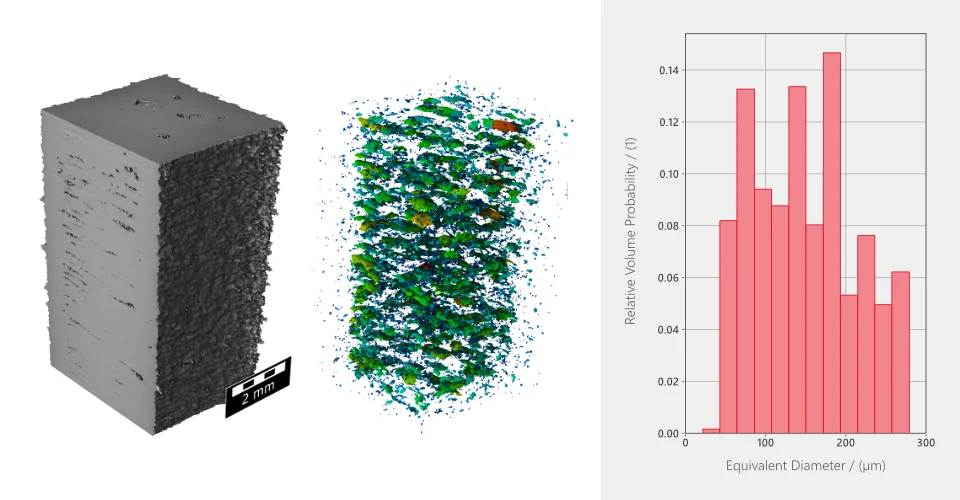
Above are listed some application fields, more can be found in [5]. One specific popular application is shown below in Figure 2: porosity analysis. In this example the additively manufactured (3d printed) sample contains pores that are segmented and analyzed using the PoroDict module in GeoDict. The color-coded result shows the pores in 3D and the statistical information shows the pore size distribution.
Data processing stages
After scanning, data can move through several processing stages:
- Reconstruction: Transforming 2D projections into a 3D voxel model.
- Segmentation: Differentiating phases (e.g., solid vs void) using grey-value thresholds or AI tools.
- Visualisation: 3D rendering and slicing for inspection and reporting.
- Quantification: Calculating metrics such as porosity, tortuosity, and fibre length.
- Simulation: Using the images to create digital material simulations, to predict material performance.
Micro CT Software
Most micro CT hardware vendors offer some reconstruction software capabilities (stage 1 in above list) included in their systems. Some development is still taking place with some vendors offing AI-powered reconstruction and iterative reconstruction.
Stages 2-5 are offered by separate micro CT software tools, sometimes sold together with CT hardware, and sometimes separately. Popular micro CT software solutions include VG Studio MAX, Avizo and GeoDict. These tools enable segmentation, quantitative analysis, and direct simulation or export to simulation platforms.
Segmentation is one of the most important steps where each pixel is assigned a material type. Sometimes this requires image processing (e.g. smoothing of noise in the image). Segmentation is often manual work, but some automated tools exist and tools vary by software solution. Manual segmentation methods based on thresholding are the most widely used and fastest. AI segmentation is powerful for challenging cases, when manual methods fail.
Visualization is the step used to create 3D images representing the object or its internal details. Visualization tools include clipping, transparency and highlighting segmented features. Often 3D animations are used to emphasize the 3D nature of the results.
Quantification is used to calculate values and extract useful information from the segmented datasets. For example, if all pores are segmented, the pore volumes, sphericities and aspect ratios can be calculated for each pore individually and color coded for 3D visualization or represented as a full quantification over the volume in statistical histograms.
Simulation is used to predict material performance. This can refer to mechanical simulation, e.g. compression testing. It can also refer to fluid flow simulation in porous materials, or thermal or electrical conductivity. Using CT data as input to simulations allow to better understand real materials performance compared to idealized design models and use this information to design better materials.
How GeoDict Supports Micro CT Workflows
GeoDict, developed by Math2Market GmbH, bridges the gap between imaging and simulation with built-in modules for the entire micro CT workflow:
- Import of 3D volumes: Directly load micro CT scan data as voxel models. Included is segmentation and image processing options, including AI segmentation.
- Quantification: quantify materials details using dedicated modules for porosity, fibers and general materials structural analysis.
- Simulation modules: Analyse transport, mechanical, electrical, or thermal properties.
- Structure–performance link: Quantify how microstructure affects material behavior.
- Digital material development: Optimize materials and processes using a simulation-driven approach.
- Application versatility: Modules for battery research, filtration, digital rock physics, additive manufacturing, and more.
GeoDict excels at covering the entire workflow, allowing detailed materials analysis and taking that one step further to simulation and materials performance prediction. Researchers and engineers using micro CT imaging can therefore progress from visualization to prediction, making GeoDict a key element in modern digital material workflows.
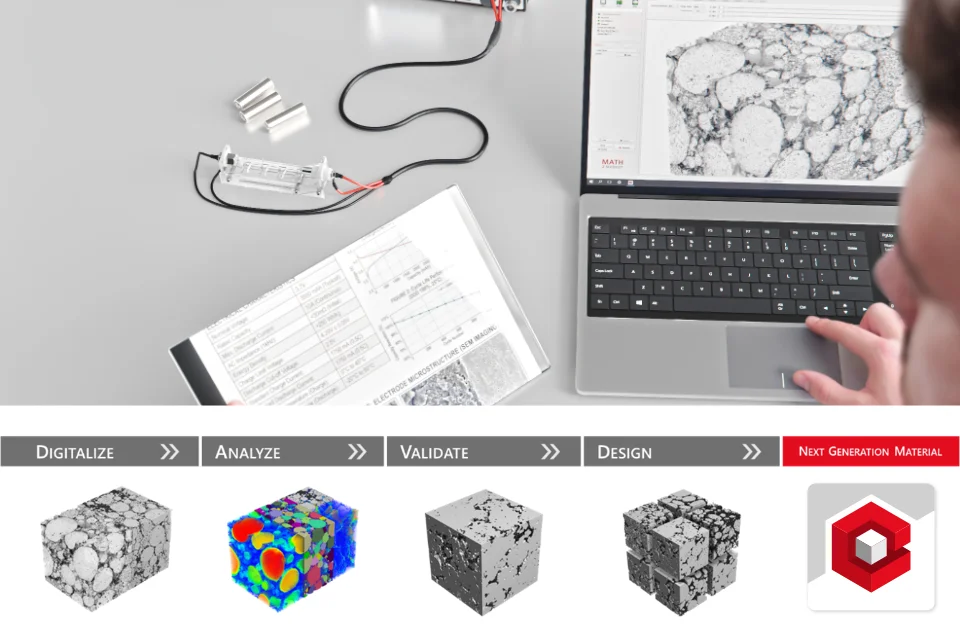
Are you interested in testing the micro-CT workflow with GeoDict? Math2Market offers a free trial license that allows you to test the software's features.
With the trial version, you can use the software for 14 days to
- Import and visualize 3D structures,
- Perform simulations,
- Explore the functions of the various modules and
- Evaluate how GeoDict supports your research or product development tasks.
To request your trial license or learn more about GeoDict's features, visit the page
Conclusion
Micro CT is a powerful imaging technique that delivers detailed, non-destructive insight into internal structures at the micrometre scale.
It enables researchers and engineers to visualise, measure, and model materials in three dimensions — essential for modern R&D across materials science, energy, and manufacturing.
By combining micro CT imaging with simulation tools like GeoDict, users can go beyond imaging to understand and optimise performance based on real microstructure data.
Interested in exploring micro CT workflows with GeoDict? Contact Math2Market GmbH for a consultation or demonstration.
References / Further Reading
https://www.sciencedirect.com/journal/tomography-of-materials-and-structures
Du Plessis, A., Yadroitsev, I., Yadroitsava, I. and Le Roux, S.G., 2018. X-ray microcomputed tomography in additive manufacturing: a review of the current technology and applications. 3D Printing and Additive Manufacturing, 5(3), pp.227-247. https://www.liebertpub.com/doi/10.1089/3dp.2018.0060
Du Plessis, A., le Roux, S.G. and Guelpa, A., 2016. Comparison of medical and industrial X-ray computed tomography for non-destructive testing. Case Studies in Nondestructive Testing and Evaluation, 6, pp.17-25. https://doi.org/10.1016/j.csndt.2016.07.001
Du Plessis et al. (2019). Scientific African, 3:e00061 – Advancing X-ray micro computed tomography in Africa. 10.1016/j.sciaf.2019.e00061
