Pore Analysis
Why Porosity Matters in Materials
created by Anton Du Plessis, Ph. D.
Porous structures are present in a wide range of natural and engineered materials. Their geometry, connectivity, and size distribution strongly influence mechanical, thermal, chemical, and transport properties. Pore analysis plays a central role in materials science, geosciences, energy storage, filtration, catalysis, manufacturing engineering and many other application areas.
This article provides an overview of what pores are, why pore analysis matters, how pores are classified and measured, and how modern image-based modeling and simulation tools, such as GeoDict, enable advanced pore characterization beyond classical measurements.
What Is a Pore? Fundamental Concepts in Pore Analysis
A pore is a void space within a solid material. Depending on the context, pores may also be referred to as voids, pore spaces, or porosity. These terms are often used synonymously, although porosity typically describes the total volume fraction of all pores relative to the total sample volume.
Context-Dependent Definitions of Pores
The precise naming and description of a pore depends on the material system and application, some examples are:
- Manufactured materials with unintentional pores
Pores may form due to trapped gases, shrinkage, or process instabilities during the manufacturing process, such as in molding, casting, or sintering.
These pores can be classified as defects and often act as weak points, reducing mechanical strength and fatigue resistance. In industrial quality control, excessive porosity may lead to part rejection. - Natural porous structures
In rocks and sediments, pore space controls fluid storage and transport, directly affecting permeability and flow velocity in geological formations. This is important in the oil and gas industry, and pore network models are often used to simplify the description of the connected pore spaces in such rocks. Pore throats are defined as the narrow connections between large, connected pore spaces in these systems, and are important to characterize as they play a crucial role in the transport properties. - Intentionally designed porous materials
Many engineered materials are designed to be porous by intent, for example:- filtration and membrane materials
- catalysts and catalyst supports
- heat exchangers
- airflow and fluid transport components
- Depending on the manufacturing method, these pore structures may be stochastic or highly ordered.
Pore Formation Mechanisms
Pores can form through different mechanisms:
- Primary vs. secondary pores
Commonly used in geosciences:- Primary pores form during deposition
- Secondary pores form later due to dissolution, compaction, or diagenetic processes
- Manufacturing-related unintentional pores
- gas entrapment
- shrinkage during solidification
- incomplete sintering
- Designed porosity
Structures intentionally engineered to exhibit specific pore sizes, shapes, and connectivity, such as honeycomb structures or catalyst supports (e.g. in automotive catalytic converters).
Why Pore Analysis Matters Across Industries
The pore structure of a material directly determines key physical and functional properties such as permeability, strength, storage capacity, and transport behavior. Some examples are given below.
Industry-Specific Relevance of Pore Analysis
- Manufacturing and production
Pores act as stress concentrators and can cause premature failure under mechanical loading. In some industries such as in aerospace, this risk is unacceptable and manufacturers must ensure porosity is kept to an absolute minimum. Excessive porosity detected by non-destructive test (NDT) methods can often result in scrapped parts. - Energy storage (batteries and supercapacitors)
Porosity controls ion transport, electrolyte accessibility, and overall electrochemical performance. - Biomedical applications
In tissue scaffolds and drug delivery systems, pore size and connectivity influence:- cell migration
- nutrient and fluid transport
- release kinetics of active substances
- Construction materials
Porosity affects:- mechanical strength
- thermal conductivity
- moisture transport and durability
- Rocks and geosciences
Pore connectivity determines permeability, influencing oil, gas, and fluid storage and migration in subsurface reservoirs. - Catalysts
A porous structure provides a high surface-to-volume ratio, enabling efficient fluid–surface contact and improved catalytic reaction rates.
Pore Size Classification
Pores are commonly categorized by size ranges, typically based on the mean pore diameter. The exact definitions vary by field and application, but commonly used size-based namings include:
- Nanopores
- Micropores
- Mesopores
- Macropores
The classification generally reflects the measurement scale rather than a strict universal definition. For example, a pore with a diameter of approximately 10 µm may be considered a micropore in certain engineering contexts.
Functional Classification by Connectivity
Beyond size, pores are often classified by their connectivity and functionality:
- Open vs. closed pores
Pores connected to the surface (or outside) of the part are classified as “open”, while pores fully enclosed and unconnected to the surface are classified as “closed”. - Effective vs. non-effective porosity
Common in reservoir engineering, where only connected pores contribute to flow and transport.
Pore Analysis Methods: Measuring Pores and Porosity
A wide range of experimental techniques exists for pore characterization. Each method provides different information and comes with specific advantages and limitations.
Common Pore Measurement Techniques
- Materialography / Metallography
- 2D section-based analysis of pore morphology, often using an optical microscope.
- Micro-CT (X-ray computed tomography)
- Non-destructive 3D imaging of pore structure and connectivity.
- SEM and FIB-SEM
- High-resolution surface and volume imaging at micro- to nanoscale using scanning electron microscope.
- Porosimetry
- The volume of a non-wetting fluid forced into the medium is calculated
- Gas or liquid-based methods, mercury intrusion porosimetry is widely used
- Used for catalysts, pharmaceuticals, construction materials and rocks
- Adsorption techniques
- Quantify pore volume, surface area, and pore size distribution by measuring gas uptake at varying pressures
- Commonly used for nanoporous materials
- Capillary Flow Porometry
- Uses liquid expulsion calculations
- Non-destructive measurement of pore throat sizes, especially in membranes and filtration media
- Thermoporometry / Cryoporometry
- Thermal methods based on melting and freezing behavior in confined pores.
- NMR in porous media
- Measures porosity by detecting the total volume of Hydrogen-rich fluids like water and oil in pore spaces
- Provides information on pore size distribution, fluid saturation and wettability
- Imbibition and evaporation methods
- Simpler or complementary approaches reflecting connectivity and permeability.
Table of most widely used methods for porosity measurement
| Method | Advantages | Limitations | Destructive? | Pore size range |
|---|---|---|---|---|
| Materialography / Metallography | 2D analysis of pores, relatively easy | Resolution limited by optical microscope approx. 1 µm, only 2D information | Yes | 1 - 10 000 µm |
| Micro-CT (X-ray computed tomography) | 3D analysis of pores, real morphology measured directly | Limited resolution depending on system and sample size | No | 1 - 10 000 µm |
| SEM and FIB-SEM | 2D and 3D analysis of pores at high resolution | SEM is limited in sample size and FIB-SEM is slow and destructive | Yes | 10 nm – 100 µm |
| Porosimetry | Standardized experimental testing, best at connected porosity | Not for closed pores, and assumptions of cylindrical pore throats | Yes | 3 nm – 300 µm |
Key Metrics Used in Pore Analysis
Quantitative pore analysis relies on a range of geometrical and topological metrics, including:
- Total pore volume
- Porosity (pore volume fraction)
- Pore size distribution
- Specific surface area
- Open vs. closed porosity
- Pore connectivity
- Pore throat sizes
More advanced descriptors include:
- inscribed and circumscribed sphere diameters
- minimum and maximum inscribed spheres
- Feret diameters and longest axes
- pore network models
- shape factors and sphericity
These metrics can be defined differently in 2D and 3D, which has a strong impact on interpretation.
Image Analysis of Pores: From Pixels to Quantitative Data
Modern pore analysis increasingly relies on image-based methods, particularly for Micro-CT and microscopy data.
Image Segmentation and Analysis
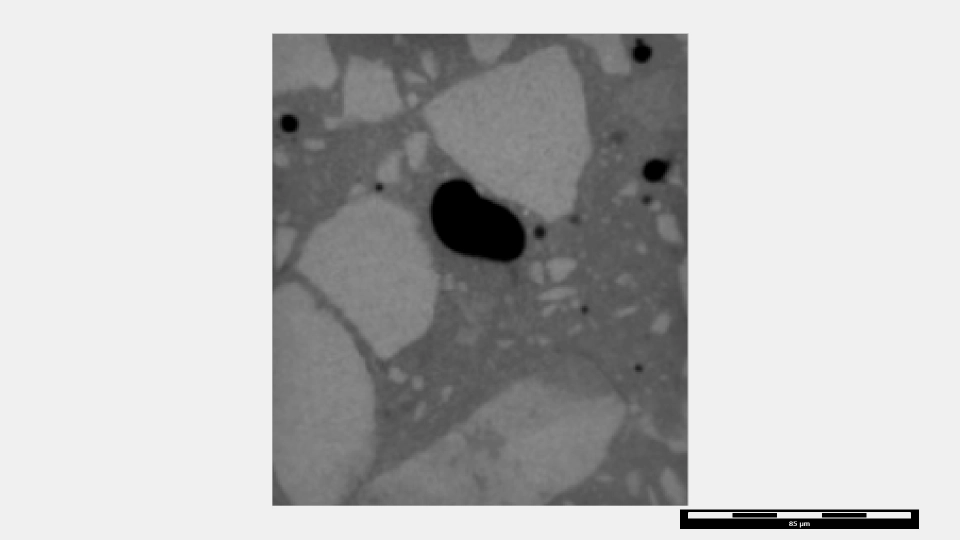
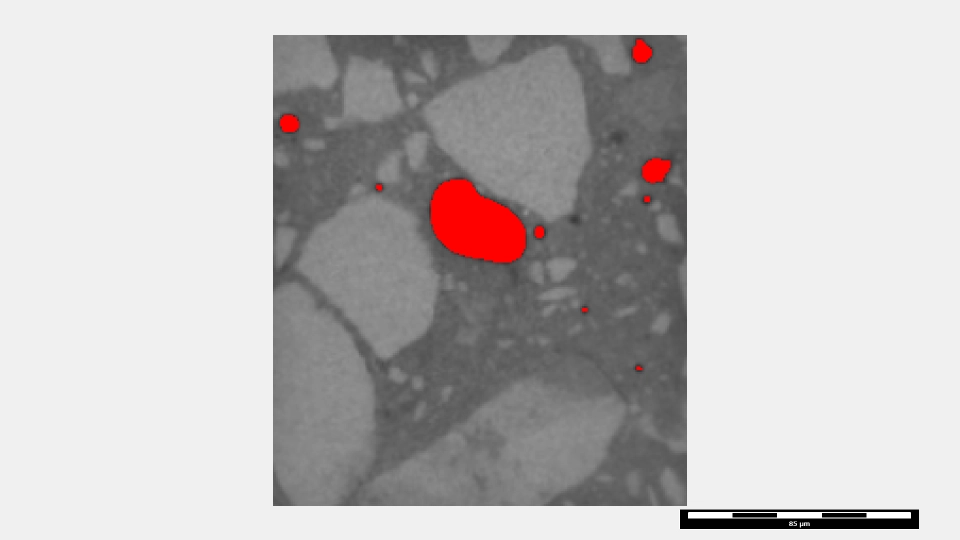
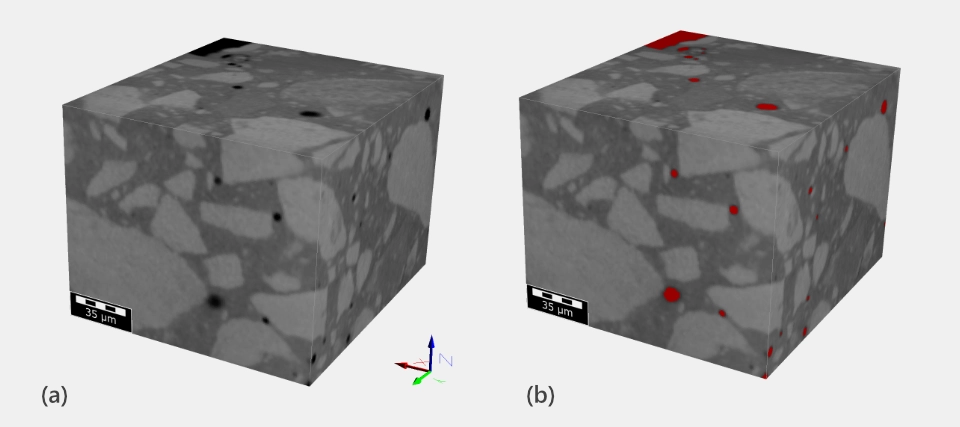
The core concept is the segmentation of pore space from solid material, followed by quantitative analysis. Segmentation of porosity often makes use of thresholding-based methods (such as Otsu’s method) based on the greyvalue distribution of the full image, to classify or segment pixels or voxels into pore space.
2D vs 3D Analysis
- 2D analysis has some advantages:
- is fast and relatively simple
- provides quantitative porosity information
- and is easy to interpret and visualize
- 2D analysis has some disadvantages:
- the 2D section analyzed may not be representative of the full volume
- pore sizes are often underestimated, e.g. image a sphere with multiple sections taken through it, most will have smaller diameter in 2D than the central slice
- misinterpretation of irregular shapes pores, e.g. imagine a curved (“banana-shaped”) pore, in some orientations in 2D it will seem to be two separate pores but is in fact one
- 3D analysis captures true pore geometry and connectivity and is therefore essential for transport-related properties. The disadvantage is that high quality imaging is more complex and may be more time consuming or expensive.
Resolution and Smallest Measurable Pore
There are some challenges involving pore segmentation in images, including the following:
- Noisy images can result in lots of “false positive” segmentations of pores
- Image brightness variations or poor contrast can make a global threshold unsuitable
- Image artifacts can result in false segmentations or missed pores
- Small pores are subject to partial volume effect, causing an increase in their brightness, resulting in under-segmentation or missed segmentations
Noise issues are usually solved by applying de-noising image filtering (see image processing). Brightness variations, poor contrast or image artifacts can lead to unsuccessful segmentation and recommending improved image acquisition.
However, there are fundamental limits of the digital pore analysis method when it comes to small pores. For example, if your pixel or voxel size is 10 µm, this does not mean that a pore can be quantified with this size.
If a pore exists in the material, its image needs to have a few pixels across its width to properly identify it and overcome the partial volume effect. Ideally, more than 10 pixels to clearly see a pore space is recommended when working with simulations.
However, for less demanding materials characterization and non-destructive testing needs, a common rule of thumb is that a pore must span at least three voxels in one dimension to be reliably detected.
Typically, digital pore analysis excludes those with smaller dimensions. It is therefore important to quantify and record the range of pore sizes measured, since smaller pores can still exist in the material.
Connectivity Definitions
Connectivity depends on how voxel neighbors are defined:
- face-connected
- edge-connected
- corner-connected
The connectivity definitions can be used to define if neighbouring pore spaces are connected or not, depending on if two voxels, one of each pore, are adjacent to each other face-to-face, only by edges touching, or only by corners touching.
Watershed Separation
Watershed algorithms are commonly used to separate connected pore regions into individual pores for statistical analysis. This procedure is useful when analyzing large open connected pore spaces.
Simulation-Based Pore Analysis: From Structure to Material Properties
Modern pore analysis does not stop at measuring pore size distributions or porosity. Once the pore space is available as a 3D digital representation, it becomes possible to simulate physical processes directly within the pore structure. This enables quantitative predictions of material behavior that are difficult or impossible to obtain from experiments alone.
Why Simulation in porous materials?
Classical pore metrics describe what the structure looks like.
Simulation-based analysis answers what the structure does.
By numerically solving physical equations inside the real pore geometry, one can link microstructure directly to functional material properties, such as transport, flow, or effective material coefficients.
Transport and Flow Simulations in Porous Media
One of the most common applications of simulation-based pore analysis is the prediction of transport properties, including:
- Permeability
Simulation of fluid flow through the connected pore space to quantify permeability in different directions. - Tortuosity
Calculation of effective transport path lengths for fluids, ions, or gases through complex pore networks. - Diffusion and conduction
Modeling of diffusive transport (e.g. ions, gases) or electrical and thermal conduction through porous structures.
These simulations are directly based on the true 3D pore geometry, capturing effects of:
- pore connectivity
- bottlenecks and pore throats
- anisotropy
- dead-end pores
Pore Network Extraction and Reduced Models
For large or highly resolved datasets, pore space can be converted into simplified pore network models:
- The continuous pore space is reduced to a network of pores (nodes) and throats (links)
- Also called ball-and-stick models
- Network models preserve essential topological information while enabling faster simulations
This approach is widely used in:
- filtration and membrane analysis
- battery electrodes
- rocks and reservoir engineering
Pore network models enable efficient prediction of flow, diffusion, and multiphase transport while remaining physically interpretable.
Multiphysics Simulations in Porous Structures
Simulation-based pore analysis is not limited to single physical effects. Depending on the application, multiple coupled phenomena can be modeled, such as:
- Fluid flow coupled with transport
- Electrochemical transport in battery electrodes
- Thermal transport in porous heat exchangers
- Reactive transport in catalysts
This allows investigation of structure–property relationships, for example:
- how pore size gradients affect performance
- how clogging or partial saturation changes transport
- how anisotropic pore structures influence effective properties
Multiscale Pore Analysis
Many real materials exhibit pores across multiple length scales, from nanometers to hundreds of micrometers. Simulation-based approaches allow:
- combination of high-resolution data for small pores with coarser data for large-scale structure
- upscaling of transport properties from pore scale to component scale
This is particularly relevant for:
- battery materials
- filtration media
- catalyst supports
From Measurement to Virtual Testing
Simulation-based pore analysis transforms pore characterization into a form of virtual material testing:
- properties can be evaluated without destroying samples
- design variants can be compared digitally
- sensitivity studies can be performed systematically
This closes the gap between experimental imaging, quantitative analysis, and predictive material modeling.
Digital Pore Analysis with GeoDict
GeoDict is a comprehensive digital material characterization and simulation platform developed by Math2Market. It enables image-based pore analysis combined with physics-based simulations, allowing pore geometry to be directly linked to functional material properties.
Basic Porosity Analysis with PoroDict
For many applications, pore analysis starts with a standardized image-based workflow that quantifies pore geometry and statistics from 3D data.
Using the PoroDict module, users can perform the following steps:
- Import of 3D image data
Typical sources include Micro-CT or FIB-SEM image stacks. - Segmentation of pore and solid phases
Binary or multi-phase segmentation separates pore space from the solid matrix. - Identification and analysis of individual pores
For each pore, PoroDict provides statistical descriptors such as:- pore diameter
- pore volume
- surface area and perimeter
- sphericity and shape factors
- aspect ratio
- orientation
- open vs. closed pore classification
- Visualization of pore space and analysis results
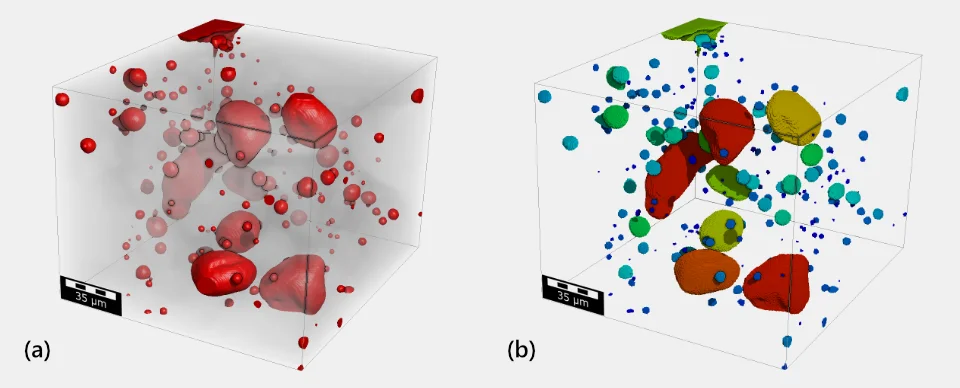
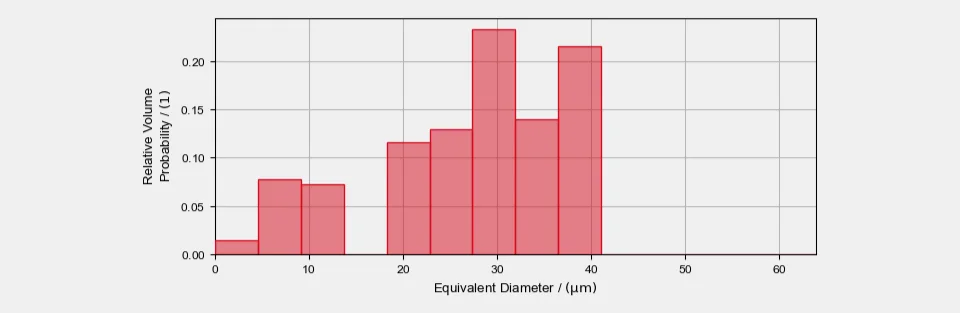
Pores can be visualized individually or color-coded by size, volume, connectivity, or other metrics.
A commonly used example is the “Identify Pores” workflow in PoroDict, which detects individual pores and generates detailed statistical reports and visualizations.

Advanced Capabilities: From Pore Geometry to Transport Properties
Beyond basic pore statistics, GeoDict supports advanced pore-based simulations that directly operate on 3D microstructures. These workflows are used when pore structure must be linked to transport, flow, or effective material behavior.
Permeability and Tortuosity from 3D Pore Structures
Using segmented pore geometries, GeoDict enables direct calculation of:
- Permeability, by simulating fluid flow through the connected pore space
- Tortuosity, based on geometric paths or physics-based transport simulations
These analyses are commonly applied in:
- digital rock physics
- battery electrode analysis
- filtration and membrane materials
Integrated Pore Analysis and Flow Simulation
In many applications, pore characterization is combined with flow simulation to obtain effective transport properties from real microstructures.
A typical example is Digital Routine Core Analysis, where GeoDict workflows combine:
- pore identification and porosity analysis (PoroDict)
- flow simulation through the pore space
- automated reporting of permeability and related metrics
This workflow is widely used in digital rock and core analysis.
From Image Data to Predictive Material Insight
By combining 3D image analysis with physics-based simulations, GeoDict enables pore analysis to move beyond descriptive metrics toward predictive digital material testing. This allows material behavior to be evaluated virtually, reducing experimental effort and supporting data-driven material development.

Are you interested in exploring the digital material development with GeoDict? Math2Market offers a free trial license that allows you to test the software’s capabilities and experience its workflow first-hand.
With the trial version, you can:
- Import and visualize 3D structures,
- Carry out pore analyses,
- Explore modules such as PoroDict, and
- Evaluate how GeoDict supports your research or product development tasks.
To request your trial license or learn more about GeoDict’s features, visit our page