CT data doesn’t have to be perfect
Hidden Gems Article #3
created by Anton Du Plessis, Ph. D.
Hidden Gems series
GeoDict is an innovative, modular software suite for digital material research and development, developed by Math2Market GmbH. It enables 3D image processing, microstructural modeling, and simulation-based material characterization and property prediction.
This series of short articles highlights selected “hidden gems” of the GeoDict software that may not be widely known. While these features are not new, they often remain underutilized in everyday workflows.
The objective is to provide concise, practical insights that support a growing user base. Each article focuses on one specific functionality and illustrates its application through a simple example. The format is intentionally brief and application oriented, allowing readers to quickly assess potential relevance for their own work.
For a more detailed demonstration or to discuss specific use cases, direct contact is welcome!
1. Introduction
X-ray computed tomography (CT) is a powerful technology for revealing the internal structure of materials and products. Its capabilities are well documented, and there is no shortage of articles showcasing what can be achieved with CT and CT data.
This article takes a different perspective. Instead of focusing on the strengths of CT, it addresses some of its common challenges and shows how GeoDict helps to overcome them efficiently.
These capabilities are often overlooked. In fact, many users are not aware that GeoDict is particularly well suited for working with XCT data. For this reason, this particle is part or our “Hidden Gems’ series, highlighting features that deserve more attention.
The focus here is on how easily CT datasets can be handled in GeoDict and how their quality can be improved for further analysis.
Using two example datasets, the following topics are covered:
- Importing CT datasets with the ImportGeo-Vol module
- Removal of ring artifacts
- Denoising and smoothing
- Cropping
- Segmentation options
2. Import CT data
Before starting any work in GeoDict, it is recommended to define a project folder to ensure that all results are saved to the intended location. This can be done via File → Select Project Folder.
GeoDict provides the ImportGeo-Vol module for importing a wide range of 3D dataset formats. Standard formats such as image stacks and RAW files are supported, along with more specialized options. One example is the TXM format, commonly used in Zeiss X-ray microscopy. These files can be imported directly, including voxel size and domain dimensions (extent in X,Y and Z), without requiring additional user input. Further details on supported formats can be found on the GeoDict website: https://www.math2market.com/geodict-software/geodict-base-modules/import-image-processing/importgeo-vol.html.
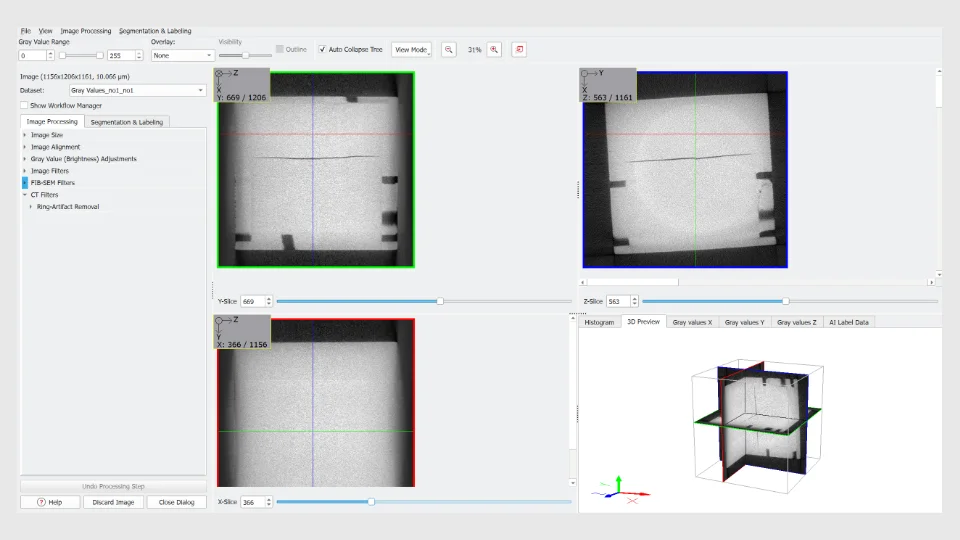
Once the volumetric data is loaded, the Image Processing dialog opens automatically. This interface is designed specifically for image processing and segmentation, providing a streamlined workspace separate from the main GeoDict environment. The dataset displayed here is an additively manufactured ceramic cube containing an internal crack, from research published in https://doi.org/10.1016/j.aime.2021.100052. The interface shows three orthogonal slice views alongside a simplified 3D preview, supporting efficient inspection and processing.
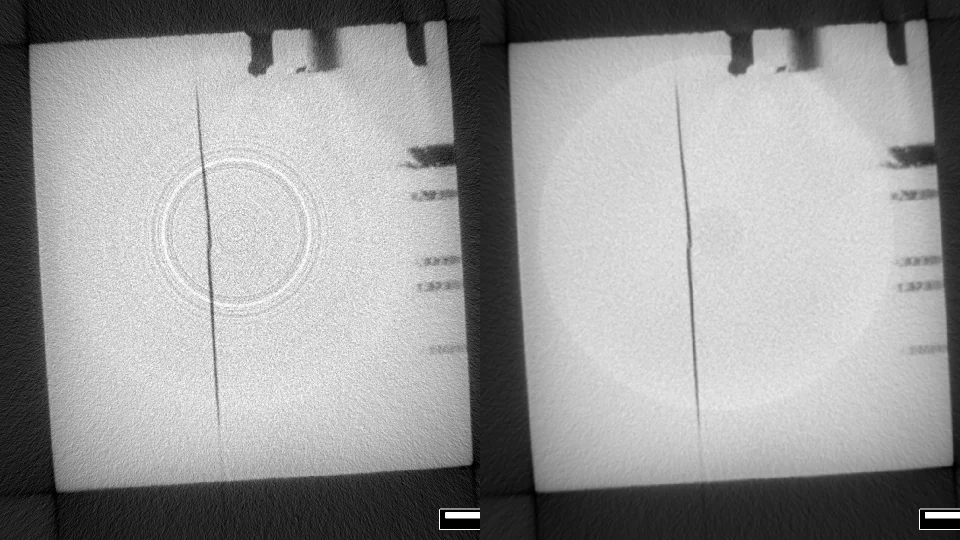
Within the image processing menu, a range of tools is available, including cropping, alignment and rotation, brightness adjustment, filtering, and CT-specific artifact correction. One common issue in CT data is the presence of ring artifacts. These can be effectively reduced using dedicated correction tools. The example shown demonstrates the removal of ring artifacts in the XY plane, both for the full field-of-view and in a high-contrast close-up, highlighting the improvement in image quality.
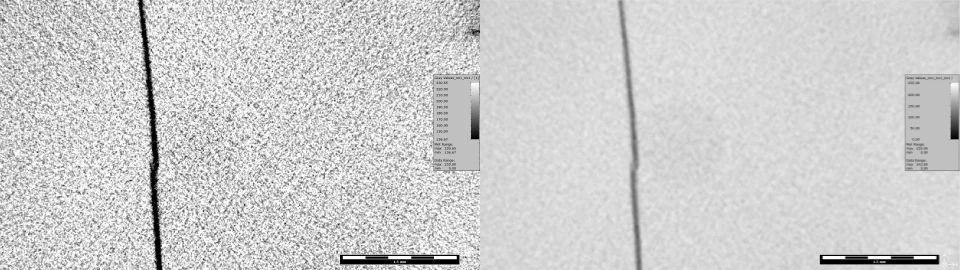
Following artifact correction, a de-noising or smoothing step is typically applied. This helps to reduce noise and improves the robustness of subsequent segmentation. GeoDict offers several filtering options, including median, Gaussian and non-local means filters. In this case, the non-local means filter is used, as it preserves fine features such as cracks and small pores. The before-and-after comparison illustrates how noise is reduced while important structural details remain intact.
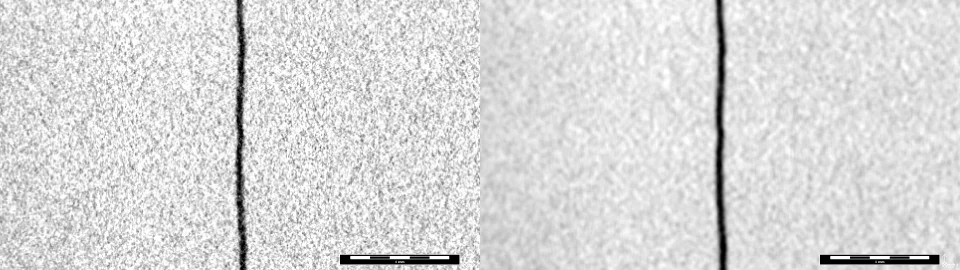
Some datasets may contain artifacts that cannot be fully corrected through filtering. Cone beam artifacts, often present in microCT systems, are one such example. A practical solution in these cases is to remove affected regions through cropping. Combined with alignment and smoothing, this leads to a clean and consistent dataset for further analysis (to the right). These steps can be performed manually or using automated tools.
The second dataset presented here is an additively manufactured titanium alloy sample with lack-of-fusion porosity. After processing, the dataset is well prepared for segmentation and analysis. Additional background on CT in additive manufacturing is available in the e-book on the topic.
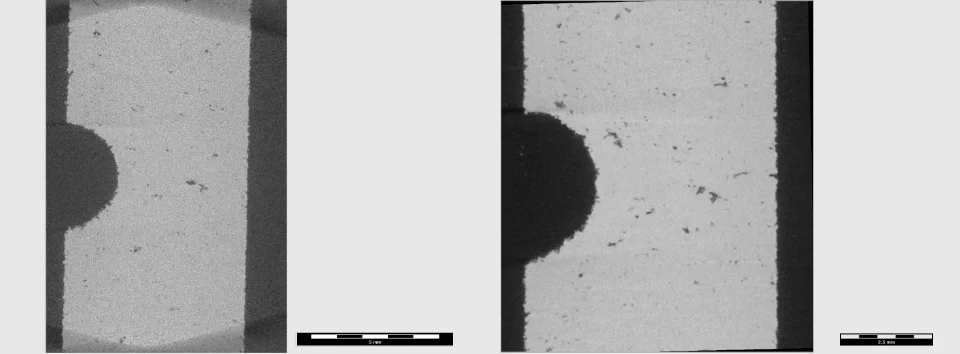
The improvements achieved through these processing steps are representative of typical workflows. Enhanced image quality directly supports more accurate segmentation, enabling reliable 3D visualization and advanced quantitative analysis. For example, the processed ceramic dataset reveals a fully planar crack geometry, while in the titanium sample, pores can be analyzed and visualized based on equivalent diameter, illustrating just one of many available quantification options.